Ch.8 - Reactions of Alkenes
Wade - Organic Chemistry 9th Edition
Wade9th EditionOrganic ChemistryISBN: 9780135213728Non è quello che usi tu?Cambia libro di testo
Capitolo 8, Problema 47b

Limonene is one of the compounds that give lemons their tangy odor. Show the structures of the products expected when limonene reacts with an excess of each of these reagents.
Chemical structure of limonene, a compound contributing to the tangy odor of lemons.
b. m-chloroperoxybenzoic acid

Guida verificata passo dopo passo
1
Step 1: Identify the functional groups in limonene. Limonene is a terpene with a cyclic structure containing a double bond in the ring and an exocyclic double bond.
Step 2: Understand the reaction mechanism of m-chloroperoxybenzoic acid (mCPBA). mCPBA is a peracid commonly used for epoxidation of alkenes. It reacts with double bonds to form epoxides.
Step 3: Determine the sites of reaction. In limonene, there are two double bonds: one in the ring and one exocyclic. Both double bonds can undergo epoxidation when treated with excess mCPBA.
Step 4: Predict the products. The reaction will yield two epoxides: one where the double bond in the ring is converted to an epoxide, and another where the exocyclic double bond is converted to an epoxide. These reactions occur independently at each double bond.
Step 5: Draw the structures of the products. For the ring double bond, the epoxide will form across the two carbons of the double bond. For the exocyclic double bond, the epoxide will form across the two carbons of the exocyclic double bond. Ensure stereochemistry is considered if applicable.

Risposta video verificata per un problema simile:

Questa soluzione video è stata consigliata dai nostri tutor come utile per risolvere questo problema.
Durata del video:
1m

Concetti chiave

Ecco i concetti essenziali che devi comprendere per rispondere correttamente alla domanda.

Limonene Structure and Properties

Limonene is a cyclic monoterpene with a distinctive structure featuring a six-membered ring and a double bond. It is known for its citrus aroma and is commonly found in the peels of citrus fruits. Understanding its structure is crucial for predicting its reactivity with various reagents, as the presence of double bonds makes it susceptible to electrophilic addition reactions.
Video consigliato:
Percorso guidato
1:19
Polymers Structure and Properties Concept 1

Epoxidation Reaction

Epoxidation is a chemical reaction that converts alkenes into epoxides, which are three-membered cyclic ethers. This reaction can be facilitated by reagents such as m-chloroperoxybenzoic acid (m-CPBA). The formation of an epoxide from limonene involves the addition of an oxygen atom across the double bond, resulting in a more reactive intermediate that can undergo further transformations.
Video consigliato:
01:37
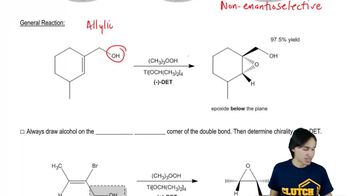
General reaction of Sharpless Epoxidation.

Reactivity of Epoxides

Epoxides are highly reactive due to the strain in their three-membered ring structure. They can undergo ring-opening reactions in the presence of nucleophiles, leading to the formation of diols or other functional groups. Understanding the reactivity of epoxides is essential for predicting the products formed when limonene reacts with m-CPBA, as the subsequent reactions can yield various alcohols or other derivatives.
Video consigliato:
02:19
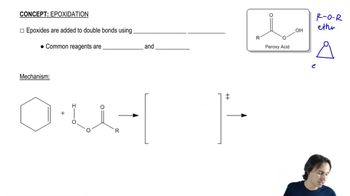
General properties of epoxidation.