Ch.8 - Reactions of Alkenes
Wade - Organic Chemistry 9th Edition
Wade9th EditionOrganic ChemistryISBN: 9780135213728Non è quello che usi tu?Cambia libro di testo
Capitolo 8, Problema 34a,b

Predict the major products of the following reactions, including stereochemistry.
a. cyclohexene + KMnO4/H2O (cold, dilute)
b. cyclohexene + peroxyacetic acid in water

Guida verificata passo dopo passo
1
Step 1: For reaction (a), recognize that cyclohexene reacts with cold, dilute KMnO4 in water to undergo syn-dihydroxylation. This reaction adds two hydroxyl (-OH) groups across the double bond of the cyclohexene in a syn (same side) fashion.
Step 2: Draw the structure of cyclohexene and identify the double bond. The double bond will be the site of the reaction where the hydroxyl groups are added.
Step 3: Add two hydroxyl groups (-OH) to the carbons of the double bond in a syn fashion. This means both hydroxyl groups will be on the same face of the cyclohexane ring, resulting in a cis-1,2-diol as the product.
Step 4: For reaction (b), recognize that cyclohexene reacts with peroxyacetic acid in water to form an epoxide. This reaction is known as epoxidation, where the double bond reacts with the peroxyacid to form a three-membered cyclic ether (epoxide).
Step 5: Draw the structure of cyclohexene and identify the double bond. Replace the double bond with an epoxide ring (a three-membered oxygen-containing ring). Ensure to consider stereochemistry, as the epoxide will form on one face of the cyclohexane ring.

Risposta video verificata per un problema simile:

Questa soluzione video è stata consigliata dai nostri tutor come utile per risolvere questo problema.
Durata del video:
11m

Concetti chiave

Ecco i concetti essenziali che devi comprendere per rispondere correttamente alla domanda.

Oxidation Reactions

Oxidation reactions involve the addition of oxygen or the removal of hydrogen from a molecule. In the context of cyclohexene reacting with KMnO4, this reaction leads to the formation of diols through syn-dihydroxylation, where hydroxyl groups are added to adjacent carbon atoms in a cyclic manner, preserving stereochemistry.
Video consigliato:
03:20
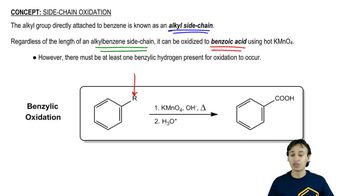
Benzylic Oxidation

Stereochemistry

Stereochemistry refers to the spatial arrangement of atoms in molecules and how this affects their chemical behavior. In reactions involving alkenes like cyclohexene, the stereochemical outcome is crucial, especially in syn-addition reactions, where the orientation of substituents on the resulting product can lead to different isomers.
Video consigliato:
Percorso guidato
1:38
Polymer Stereochemistry Concept 1

Peracid Reactions

Peracid reactions involve the use of peracids, such as peroxyacetic acid, to oxidize alkenes. This reaction typically results in the formation of epoxides or diols, depending on the conditions. The mechanism involves the electrophilic attack of the peracid on the double bond, leading to the formation of a cyclic ether (epoxide) that can further react with water to yield diols.
Video consigliato:
05:09
Heck Reaction