Ch.8 - Reactions of Alkenes
Wade - Organic Chemistry 9th Edition
Wade9th EditionOrganic ChemistryISBN: 9780135213728Non è quello che usi tu?Cambia libro di testo
Capitolo 8, Problema 25

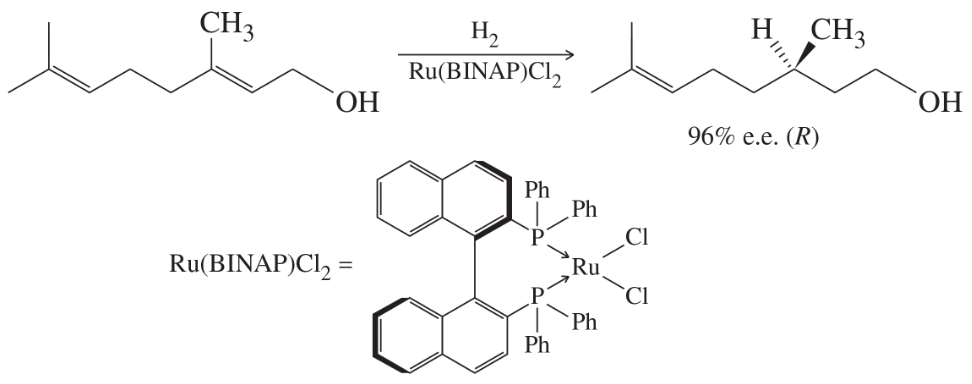
The chiral BINAP ligand shown in Figure 8-8 contains no asymmetric carbon atoms. Explain how this ligand is chiral.

Guida verificata passo dopo passo
1
The BINAP ligand is chiral due to its axial chirality, which arises from the spatial arrangement of the two naphthyl groups connected to the phosphorus atoms. These groups are twisted relative to each other, creating a non-superimposable mirror image.
Unlike traditional chirality that involves asymmetric carbon atoms, axial chirality is a result of restricted rotation around a bond, leading to a fixed spatial arrangement of substituents.
In the BINAP ligand, the bulky naphthyl groups prevent free rotation around the bond connecting them to the phosphorus atoms, locking the molecule into a specific chiral conformation.
The chirality of BINAP is crucial in asymmetric catalysis, as it allows the ligand to induce stereoselectivity in reactions, such as the hydrogenation shown in the figure, where the Ru(BINAP)Cl₂ catalyst produces the (R)-enantiomer with high enantiomeric excess (96% e.e.).
The structure of BINAP demonstrates that chirality can exist without asymmetric carbon atoms, broadening the understanding of stereochemistry in organic molecules and catalysts.

Risposta video verificata per un problema simile:

Questa soluzione video è stata consigliata dai nostri tutor come utile per risolvere questo problema.
Durata del video:
2m

Concetti chiave

Ecco i concetti essenziali che devi comprendere per rispondere correttamente alla domanda.

Chirality

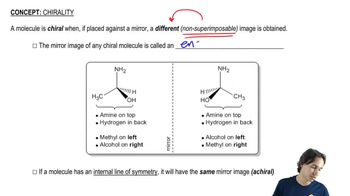
Chirality refers to the geometric property of a molecule that makes it non-superimposable on its mirror image, akin to how left and right hands are distinct. A molecule can be chiral even without asymmetric carbon atoms if it has a specific spatial arrangement that creates two non-superimposable forms, known as enantiomers. This is crucial in understanding how certain ligands, like BINAP, can exhibit chirality through their overall three-dimensional structure.
Video consigliato:
05:10
What is chirality?

BINAP Ligand

BINAP (1,1'-bi-2-naphthol) is a bidentate ligand commonly used in asymmetric catalysis. It features two naphthalene rings connected by a single bond, allowing it to coordinate to metal centers, such as ruthenium in the provided example. The unique arrangement of its substituents can create a chiral environment around the metal, facilitating selective reactions that produce specific enantiomers.
Video consigliato:
02:01
Ligands

Asymmetric Catalysis

Asymmetric catalysis is a process where a catalyst induces the formation of one enantiomer over another in a chemical reaction. This is particularly important in organic synthesis, as it allows for the production of chiral molecules with high enantiomeric excess (e.e.). The use of chiral ligands like BINAP in conjunction with transition metals enables chemists to achieve high selectivity in reactions, as seen in the hydrogenation example provided.
Video consigliato:
Percorso guidato
2:31
Nucleophilic Catalysis Concept 1