Ch.8 - Reactions of Alkenes
Wade - Organic Chemistry 9th Edition
Wade9th EditionOrganic ChemistryISBN: 9780135213728Non è quello che usi tu?Cambia libro di testo
Capitolo 8, Problema 16a

When HBr adds across the double bond of 1,2-dimethylcyclopentene, the product is a mixture of the cis and trans isomers. Show why this addition is not stereospecific.

Guida verificata passo dopo passo
1
Identify the type of reaction: The addition of HBr to 1,2-dimethylcyclopentene is an electrophilic addition reaction, where the π-electrons of the double bond attack the electrophilic hydrogen of HBr, leading to the formation of a carbocation intermediate.
Analyze the intermediate: The double bond in 1,2-dimethylcyclopentene is planar, and the formation of the carbocation intermediate occurs at the more substituted carbon (Markovnikov's rule). This results in a planar sp²-hybridized carbocation, which can be attacked by the bromide ion (Br⁻) from either the top or bottom face of the planar intermediate.
Explain the lack of stereospecificity: Since the bromide ion can attack the carbocation from either face, two different stereoisomers (cis and trans) can form. This non-selective attack is the reason the reaction is not stereospecific.
Consider the stereochemistry of the product: The cis and trans isomers arise because the substituents (the two methyl groups) on the cyclopentane ring can end up on the same side (cis) or opposite sides (trans) of the ring, depending on the face of attack by the bromide ion.
Summarize the conclusion: The addition of HBr to 1,2-dimethylcyclopentene is not stereospecific because the planar carbocation intermediate allows for equal probability of attack by the nucleophile (Br⁻) from either face, leading to a mixture of stereoisomers.

Risposta video verificata per un problema simile:

Questa soluzione video è stata consigliata dai nostri tutor come utile per risolvere questo problema.
Durata del video:
10m

Concetti chiave

Ecco i concetti essenziali che devi comprendere per rispondere correttamente alla domanda.

Electrophilic Addition

Electrophilic addition is a reaction mechanism where an electrophile reacts with a nucleophile, typically across a double bond. In the case of alkenes, such as 1,2-dimethylcyclopentene, the double bond acts as a nucleophile, attacking the electrophile (HBr). This process leads to the formation of a carbocation intermediate, which can then react with the nucleophile (Br-) from either side, resulting in a mixture of products.
Video consigliato:
09:23
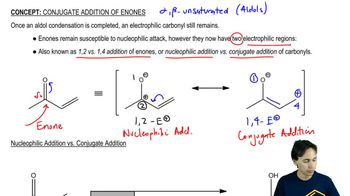
1,2 vs 1,4 Addition

Carbocation Stability and Rearrangement

Carbocations are positively charged species that can rearrange to form more stable structures. In the addition of HBr to 1,2-dimethylcyclopentene, the formation of a carbocation allows for the possibility of rearrangement or the formation of different stereoisomers. The stability of the carbocation influences the pathway of the reaction, leading to the generation of both cis and trans isomers due to the non-specific nature of the attack by the bromide ion.
Video consigliato:
05:58
Determining Carbocation Stability

Stereochemistry and Isomerism

Stereochemistry refers to the spatial arrangement of atoms in molecules and how this affects their chemical properties. In the case of the addition of HBr to 1,2-dimethylcyclopentene, the formation of both cis and trans isomers indicates that the reaction is not stereospecific. This means that the addition does not favor the formation of one stereoisomer over the other, resulting in a mixture due to the unrestricted approach of the bromide ion to the carbocation.
Video consigliato:
Percorso guidato
1:38
Polymer Stereochemistry Concept 1