

Under certain conditions, the reaction of 0.5 M 1-bromobutane with 1.0 M sodium methoxide forms 1-methoxybutane at a rate of 0.05 mol/L per second. What would be the rate if 0.1 M 1-bromobutane and 2.0 M NaOCH3 were used?
Ch.6 - Alkyl Halides; Nucleophilic Substitution
Capitolo 6, Problema 13b
Consider the reaction of 1-bromobutane with a large excess of ammonia (NH3). Draw the reactants, the transition state, and the products. Note that the initial product is the salt of an amine (RNH3+Br−), which is deprotonated by the excess ammonia to give the amine.
Guida verificata passo dopo passo1
Step 1: Identify the type of reaction. This is a nucleophilic substitution reaction (SN2 mechanism) where ammonia (NH3) acts as the nucleophile and 1-bromobutane (CH3CH2CH2CH2Br) is the substrate. The bromine atom is the leaving group.
Step 2: Draw the reactants. Represent 1-bromobutane as CH3CH2CH2CH2Br and ammonia as NH3. Show the lone pair of electrons on the nitrogen atom in NH3, which will attack the carbon atom bonded to the bromine.
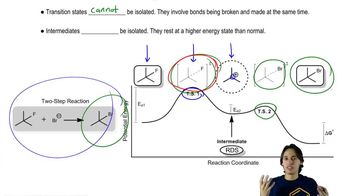
Step 3: Illustrate the transition state. In the SN2 mechanism, the nucleophile (NH3) attacks the electrophilic carbon atom from the opposite side of the leaving group (Br−). Draw a pentavalent carbon in the transition state with partial bonds to both the nucleophile (NH3) and the leaving group (Br−). Use dashed lines to represent these partial bonds.
Step 4: Draw the initial product. After the bromine leaves, the nitrogen from NH3 is bonded to the carbon chain, forming CH3CH2CH2CH2NH3+. This is the ammonium salt (RNH3+ Br−), where R = CH3CH2CH2CH2.
Step 5: Show the deprotonation step. The excess ammonia (NH3) acts as a base and removes a proton (H+) from CH3CH2CH2CH2NH3+, resulting in the formation of the neutral amine (CH3CH2CH2CH2NH2) and ammonium bromide (NH4+ Br−).

Risposta video verificata per un problema simile:
Questa soluzione video è stata consigliata dai nostri tutor come utile per risolvere questo problema.
Durata del video:
10mConcetti chiave
Ecco i concetti essenziali che devi comprendere per rispondere correttamente alla domanda.
Nucleophilic Substitution
Nucleophilic substitution is a fundamental reaction in organic chemistry where a nucleophile attacks an electrophile, resulting in the replacement of a leaving group. In the case of 1-bromobutane reacting with ammonia, the ammonia acts as a nucleophile, attacking the carbon atom bonded to the bromine, leading to the formation of an amine.
Video consigliato:
Nucleophiles and Electrophiles can react in Substitution Reactions.
Transition State
The transition state is a high-energy, unstable arrangement of atoms that occurs during a chemical reaction. It represents the point at which reactants are transformed into products. In this reaction, the transition state would involve the partial bond formation between the nitrogen of ammonia and the carbon of 1-bromobutane, as well as the partial bond breaking of the C-Br bond.
Video consigliato:
Intermediates vs. Transition States
Deprotonation
Deprotonation is the removal of a proton (H+) from a molecule, resulting in the formation of a base. In this reaction, after the initial product (RNH3+ Br−) is formed, the excess ammonia deprotonates the ammonium salt to yield the neutral amine. This step is crucial for obtaining the final product and illustrates the role of ammonia as both a nucleophile and a base.
Video consigliato:
Percorso guidato
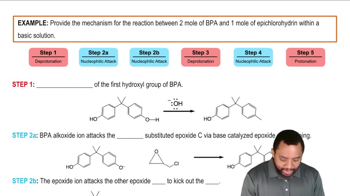
Step-Growth Polymers: Epoxy Resin Example 1
Pratica correlata
Domanda del libro di testo
920
views
Domanda del libro di testo
Classify each reaction as a substitution, an elimination, or neither. Identify the leaving group in each reaction, and the nucleophile in substitutions.
c.
1439
views
Domanda del libro di testo
Classify each reaction as a substitution, an elimination, or neither. Identify the leaving group in each reaction, and the nucleophile in substitutions.
b.
1673
views
Domanda del libro di testo
Predict the major products of the following substitutions.
b.
1849
views
Domanda del libro di testo
Under certain conditions, the reaction of 0.5 M 1-bromobutane with 1.0 M sodium methoxide forms 1-methoxybutane at a rate of 0.05 mol/L per second.
c. Show another SN2 reaction using a different combination of an alkoxide and an alkyl bromide that also produces 1-methoxybutane.
1562
views
Domanda del libro di testo
Predict the major products of the following substitutions.
a.
1048
views
