Why don't most objects exhibit static electricity despite having large numbers of charged particles?
Most objects have nearly equal numbers of positive and negative charges, making them electrically neutral.
How can you determine if a rod is positively or negatively charged?
Bring a known charged object close to the rod; if like charges repel, the rod has the same charge as the known object, otherwise it is opposite.
What is the difference between charging by conduction and charging by induction?
Charging by conduction transfers charge by contact; charging by induction induces polarization and then allows charge to flow to ground, leaving the object charged.
Why do trucks carrying gasoline have chains dragging on the ground?
To transfer excess charge safely to the ground, preventing sparks that could ignite gasoline.
Why do clothes cling together after drying, and does dampness affect this?
Drying causes static charge buildup; dampness allows water molecules to transfer electrons, reducing static cling.
What force holds an atomic nucleus together despite repulsive forces between protons?
A force stronger than electrostatic repulsion, known as the nuclear strong force, holds the nucleus together.
What is the convention for the sign of the test charge used to measure electric fields?
A positive test charge is conventionally used to measure electric fields.
What can be inferred if the electric field at a point between two charges is zero?
The two charges have the same sign and their fields cancel at that point.
Why is the electric field outside an infinite charged sheet constant?
Because the sheet is infinite, the field does not diminish with distance and remains constant everywhere.
How does the electric field behave between two infinite parallel plates with opposite charges?
The field is uniform and directed from the positive to the negative plate, zero outside the plates.
Will a point charge released from rest in a uniform electric field follow a field line?
Yes, in a uniform field it follows a field line; in a non-uniform field, it may not.
How can you experimentally distinguish an electric field from a gravitational field?
An electric field can move charged particles in directions other than toward Earth's center, unlike gravity.
What is the ratio of the number of electric field lines leaving a charge 10q compared to a charge q?
The ratio is 10:1, proportional to the magnitude of the charge.
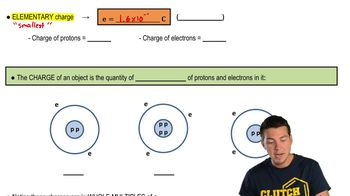
How many electrons correspond to a charge of –2.00 nC?
Approximately 1.25 × 10^10 electrons (using charge of electron e = 1.6 × 10^-19 C).
What is Coulomb's law for the force between two point charges?
The force magnitude is \(F=\frac{k|q_1q_2|}{r^2}\), where k is Coulomb's constant.
How do you calculate the electric field due to a point charge q at distance r?
Electric field magnitude is \(E=\frac{k|q|}{r^2}\), directed away from positive charges.
What is the principle of superposition for electric fields?
The net electric field is the vector sum of the fields due to individual charges.
What is the electric dipole moment and how is it calculated?
Dipole moment is \(\vec{p}=q\vec{d}\), where q is charge magnitude and d is separation vector.
How does the electric field of a dipole vary with distance?
The dipole field decreases with the cube of the distance, \(E \propto \frac{1}{r^3}\).
What is the effect of charge distribution on the electric field at a point?
The field depends on the geometry and magnitude of the charge distribution, calculated by integrating contributions from all elements.
 Indietro
 01:06
01:06