Skip to main content
Physics with Calculus
Il mio corso
Impara
Preparazione agli esami
AI Tutor
Guide di studio
Soluzioni per libri di testo
Flashcard
Esplora
Prova l'app
Il mio corso
Impara
Preparazione agli esami
AI Tutor
Guide di studio
Soluzioni per libri di testo
Flashcard
Esplora
Prova l'app
Indietro
Electric Potential - Physics with Calculus
Puoi toccare per girare la carta.
What condition must the electric field satisfy for electric potential energy to be meaningful?
Puoi toccare per girare la carta.
👆
What condition must the electric field satisfy for electric potential energy to be meaningful?
The electric field must be
conservative
to define electric potential energy.
Avanzamenti del tracciato
I pulsanti di controllo sono stati cambiati in modalità "navigazione".
1/20
Video consigliati
VideoThumbView.guidedCourse
07:51
Electric Potential Energy
20029
views
673
rank
6
comments
Termini in questo insieme (20)
Nascondere definizioni
What condition must the electric field satisfy for electric potential energy to be meaningful?
The electric field must be
conservative
to define electric potential energy.
Does the order of assembling point charges affect the total work done?
No, the total work done is independent of the order, though some orderings may simplify calculations.
What is the electric field strength in a region where the electric potential is constant?
The electric field strength is
zero
because no potential difference exists.
Which term is more descriptive: voltage or potential difference?
Potential difference
is more descriptive as it explicitly indicates the difference between potentials at two points.
How is potential difference related to electric potential energy?
Potential difference is a system property; electric potential energy of a charge is the product of the charge magnitude and the potential difference.
How do volts and electron-volts differ?
Volts measure potential difference; electron-volts are units of energy equal to one volt times the electron charge.
How does the potential outside a uniformly charged sphere compare to that of a point charge?
Outside the sphere, the potential is the same as a point charge; inside, it differs.
If the electric field is zero throughout a region, what can be said about the electric potential there?
The electric potential is
constant
but not necessarily zero.
Are there electric field lines between two points at the same potential?
No, electric field lines connect points of different potential.
Can a positively charged conductor have a negative potential?
Yes, depending on the reference point chosen for zero potential.
Why are metal support rods for satellite dishes generally grounded?
To safely direct lightning strikes into the ground, protecting equipment.
What is the relationship between electric field strength units V/m and N/C?
They are equivalent units for electric field strength.
How is the potential difference between two points related to the electric field between parallel plates?
Potential difference equals electric field strength multiplied by the distance between the points.
What is the electric field between two parallel plates separated by distance d with potential difference V?
Electric field strength is \(E=\frac{V}{d}\).
How is the potential energy of two point charges separated by distance r calculated?
Potential energy is \(U=\frac{k q_1 q_2}{r}\), where k is Coulomb's constant.
What is the potential near the surface of a uniformly charged sphere of radius R and charge Q?
Potential is \(V=\frac{kQ}{R}\) at the surface.
How does the electric potential vary inside and outside a charged spherical shell?
Outside, potential behaves like a point charge; inside, potential is constant.
What is the electric field of an infinite line charge with linear charge density λ at distance r?
Electric field magnitude is \(E=\frac{\lambda}{2\pi\epsilon_0 r}\) directed radially outward.
What is the potential difference between two concentric spherical shells with charges Q and -Q?
Potential difference is \(V=\frac{kQ}{a} - \frac{kQ}{b}\), where a and b are shell radii.
How does the electric field support the weight of a free electron near Earth's surface?
The electric field points downward with magnitude balancing gravitational force, showing electrostatic force is much stronger than gravity.
 IndietroIndietro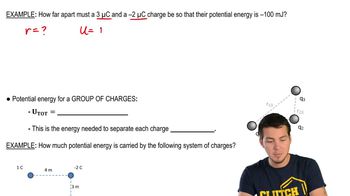
 07:51
07:51