Skip to main content
Physics with Calculus
Il mio corso
Impara
Preparazione agli esami
AI Tutor
Guide di studio
Soluzioni per libri di testo
Flashcard
Esplora
Prova l'app
Il mio corso
Impara
Preparazione agli esami
AI Tutor
Guide di studio
Soluzioni per libri di testo
Flashcard
Esplora
Prova l'app
Indietro
Gauss's Law - Electricity and Magnetism
Puoi toccare per girare la carta.
What orientation of a planar surface yields maximum electric flux in a uniform electric field?
Puoi toccare per girare la carta.
👆
What orientation of a planar surface yields maximum electric flux in a uniform electric field?
Maximum flux occurs when the surface is perpendicular to the electric field vector.
Avanzamenti del tracciato
I pulsanti di controllo sono stati cambiati in modalità "navigazione".
1/20
Video consigliati
VideoThumbView.guidedCourse
04:03
Surface Charge Density
11611
views
168
rank
3
comments
VideoThumbView.guidedCourse
10:20
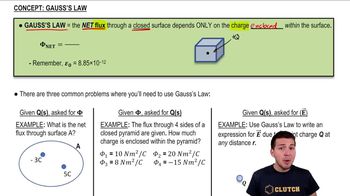
Gauss' Law
15431
views
294
rank
4
comments
VideoThumbView.guidedCourse
07:56
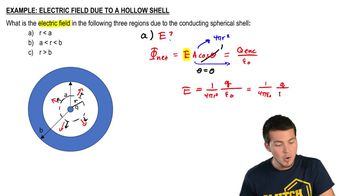
Electric Field due to Hollow Shell
10810
views
175
rank
15
comments
Termini in questo insieme (20)
Nascondere definizioni
What orientation of a planar surface yields maximum electric flux in a uniform electric field?
Maximum flux occurs when the surface is perpendicular to the electric field vector.
What orientation of a planar surface yields minimum electric flux in a uniform electric field?
Minimum flux occurs when the surface is parallel to the electric field vector.
Is the net electric flux through a closed surface always zero?
No, it is zero only if the net charge enclosed by the surface is zero.
How does the electric flux through two concentric spherical surfaces enclosing the same point charge compare?
The electric flux through both surfaces is the same, independent of their radii.
If the electric flux through a closed surface is zero, is the electric field zero everywhere on the surface?
No, the electric field may not be zero; however, the net enclosed charge is zero.
How do the gravitational field of a point mass and the electric field of a point charge compare?
Both fields vary as \(\frac{1}{r^2}\), but the gravitational field is much weaker and its flux is always zero or positive, unlike electric flux.
Does the electric field term in Gauss's law represent only the field from charges inside the Gaussian surface?
No, it includes contributions from all charges, both inside and outside the Gaussian surface.
Is Gauss's law useful for finding the electric field of two equal but opposite charges separated by a fixed distance?
No, because the lack of symmetry makes Gauss's law difficult to apply.
What restrictions exist on the shape of a Gaussian surface for planar symmetry?
Any shape can be used as long as the Gaussian integral is calculable; boxes or cylinders are most convenient.
Where does excess charge reside on a conductor under electrostatic conditions?
Excess charge resides on the surface of the conductor, not throughout its volume.
What happens to the charge distribution if a point charge is placed inside a cavity within a conductor?
An induced charge equal and opposite to the point charge appears on the cavity surface, and the outer surface carries the net excess charge.
How is electric flux through a surface related to the angle between the surface normal and the electric field?
Flux is proportional to the cosine of the angle between the surface normal and the electric field.
What is the electric field at a distance r from an infinite line charge with linear charge density λ?
The electric field magnitude is \(\frac{\lambda}{2\pi\epsilon_0 r}\) directed radially outward.
What is the net electric flux through a closed surface enclosing a point charge q?
The net flux is \(\frac{q}{\epsilon_0}\) according to Gauss's law.
How does the electric field inside a conductor behave?
The electric field inside a conductor is zero under electrostatic conditions.
What is the electric field outside a charged spherical conductor of radius R with total charge Q?
Outside the sphere, the field behaves like a point charge: \(\frac{1}{4\pi\epsilon_0} \frac{Q}{r^2}\).
How does the electric field vary inside a uniformly charged solid sphere?
Inside, the field increases linearly with distance r from the center: \(\frac{Q}{4\pi\epsilon_0 R^3} r\).
What is the electric field due to an infinite charged sheet with surface charge density σ?
The field is constant and perpendicular to the sheet: \(\frac{\sigma}{2\epsilon_0}\).
How is the electric field inside and outside a long charged cylindrical shell distributed?
Inside the shell, the field is zero; outside, it behaves like a line charge field decreasing with distance.
What is the electric field between two parallel plates with equal and opposite charges?
The field is uniform and given by \(\frac{\sigma}{\epsilon_0}\), where σ is the surface charge density.
 IndietroIndietro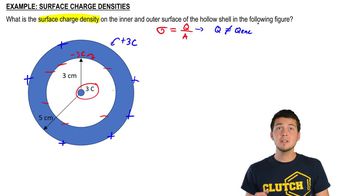
 04:03
04:03