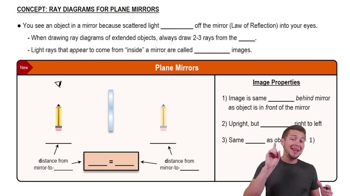
What is the nature of the image formed by a flat mirror?
The image point \(I\) is located behind the mirror a distance \(q\) from the mirror. The image is virtual.
What is the relationship between object height and image height in flat mirrors?
Because triangles PQR and P'QR are congruent, |p| = |q| and h = h', meaning the image height equals the object height.
Does a flat mirror cause left-right reversal of images?
No. The thumb on the left side of both real hands and the left side of the image shows there is no left-to-right reversal in flat mirrors.
How are multiple images formed by two perpendicular flat mirrors?
Two flat mirrors at right angles produce multiple images due to successive reflections, with image positions determined by mirror geometry.
What is the principal axis in spherical mirrors?
The principal axis is the line passing through the center of curvature \(C\) and the vertex \(V\) of the mirror.
What is the focal point of a concave mirror?
The focal point \(F\) is the point where rays parallel to the principal axis converge after reflection.
What happens to rays reflecting off a concave mirror if they diverge from the object at small angles?
They all reflect through the same image point \(I\), forming a clear image.
Where do reflected rays intersect in a concave mirror?
Reflected rays intersect at different points on the principal axis, determining the image location.
Where is the real image formed by a concave mirror located?
The real image lies at the location where the reflected rays cross in front of the mirror.
What is the mirror equation relating object distance, image distance, and radius of curvature?
The mirror equation is \(\frac{1}{p} + \frac{1}{q} = \frac{2}{R}\), where \(p\) is object distance, \(q\) is image distance, and \(R\) is radius of curvature.
What is the focal length \(f\) of a spherical mirror in terms of radius of curvature?
The focal length is \(f = \frac{R}{2}\).
What type of image is formed when the object is very far from a concave mirror?
The image distance approaches \(q \approx f = R/2\), and the image is real and inverted.
What is the nature of the image formed by a concave mirror when the object is between the focal point and the mirror?
The image is virtual, upright, and enlarged, located behind the mirror.
What is the nature of the image formed by a convex mirror?
The image is virtual, upright, and reduced in size, located behind the mirror.
What are the sign conventions for mirrors regarding object and image distances?
Object distance \(p\) and image distance \(q\) are positive if in front of the mirror (real side), negative if behind (virtual side).
What is magnification \(M\) in mirror image formation?
Magnification is \(M = -\frac{q}{p} = \frac{h'}{h}\), relating image and object distances and heights.
How do rays behave in a convex mirror?
Rays diverge after reflection, appearing to come from a virtual focal point behind the mirror.
What is the difference between real and virtual images in terms of ray intersection?
Real images form where reflected rays physically intersect; virtual images form where rays appear to diverge from a point behind the mirror.
How does the image change when the object moves closer to a concave mirror within the focal length?
The image becomes virtual, upright, and larger than the object.
What is the effect of spherical aberration in mirrors?
Spherical aberration causes reflected rays to focus at different points, blurring the image.
 Indietro
 06:27
06:27