Skip to main content
Physics with Calculus
Il mio corso
Impara
Preparazione agli esami
AI Tutor
Guide di studio
Soluzioni per libri di testo
Flashcard
Esplora
Prova l'app
Il mio corso
Impara
Preparazione agli esami
AI Tutor
Guide di studio
Soluzioni per libri di testo
Flashcard
Esplora
Prova l'app
Indietro
Newton's First Law and Equilibrium - Physics with Calculus
Puoi toccare per girare la carta.
Aristotle's classification of motion
Puoi toccare per girare la carta.
👆
Aristotle's classification of motion
Natural motion
is motion toward an object's proper place (earth, water, air, fire).
Violent motion
is caused by external pushes or pulls.
Avanzamenti del tracciato
I pulsanti di controllo sono stati cambiati in modalità "navigazione".
1/20
Video consigliati
VideoThumbView.guidedCourse
08:45
Traffic Signal
10281
views
185
rank
6
comments
VideoThumbView.guidedCourse
06:11
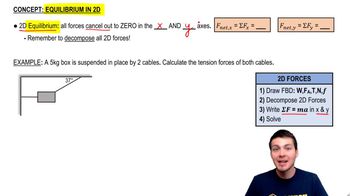
2D Equilibrium Problems
14507
views
271
rank
7
comments
Termini in questo insieme (20)
Nascondere definizioni
Aristotle's classification of motion
Natural motion
is motion toward an object's proper place (earth, water, air, fire).
Violent motion
is caused by external pushes or pulls.
Galileo's discovery about falling objects
Objects of different weight fall at the same rate without air resistance.
Inertia
Inertia
is a property of matter to resist changes in motion and depends on mass.
Newton's First Law of Motion
An object remains at rest or moves at constant velocity unless acted on by a nonzero net force.
Net force
The vector sum of all forces acting on an object.
Vector quantity
A quantity with both magnitude and direction, represented by arrows.
Scalar quantity
A quantity with magnitude only, no direction.
Resultant vector
The sum of two or more vectors, found by arithmetic addition or parallelogram rule.
Equilibrium rule
The vector sum of forces on a nonaccelerating object equals zero.
Support force (normal force)
An upward force opposing gravity, like a table pushing up on a book.
Static equilibrium
An object at rest with no net force acting on it.
Dynamic equilibrium
An object moving at constant velocity with no net force acting on it.
Effect of friction on motion
Friction causes a moving object to slow and eventually stop unless balanced by an applied force.
Parallelogram rule for vectors
Used to find the resultant of two vectors not aligned in the same or opposite directions.
Tension in ropes at different angles
Tensions differ due to angles; vector sum of tensions balances the weight in equilibrium.
Equilibrium test
If an object’s motion does not change, it is in equilibrium.
Effect of Earth's motion on objects
Objects moving with Earth maintain their horizontal motion due to inertia.
Force balance when pushing a crate at steady speed
Applied force equals friction force to maintain dynamic equilibrium.
Vector representation of forces
Arrows show magnitude and direction; longer arrows mean greater force.
Galileo's inclined plane experiments
Showed that a ball on a horizontal plane maintains speed indefinitely without friction.
 IndietroIndietro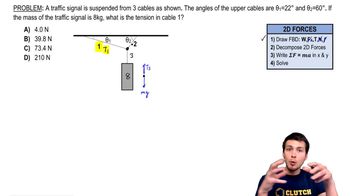
 08:45
08:45