Skip to main content
Physics with Calculus
Il mio corso
Impara
Preparazione agli esami
AI Tutor
Guide di studio
Soluzioni per libri di testo
Flashcard
Esplora
Prova l'app
Il mio corso
Impara
Preparazione agli esami
AI Tutor
Guide di studio
Soluzioni per libri di testo
Flashcard
Esplora
Prova l'app
Indietro
Physics with Calculus: Linear Motion Concepts
Puoi toccare per girare la carta.
What does it mean that motion is relative?
Puoi toccare per girare la carta.
👆
What does it mean that motion is relative?
Motion is described relative to a reference point; for example, your motion relative to Earth differs from your motion relative to the Sun.
Avanzamenti del tracciato
I pulsanti di controllo sono stati cambiati in modalità "navigazione".
1/20
Video consigliati
VideoThumbView.guidedCourse
07:33
Constant Velocity with Multiple Parts
17483
views
413
rank
5
comments
VideoThumbView.guidedCourse
05:35
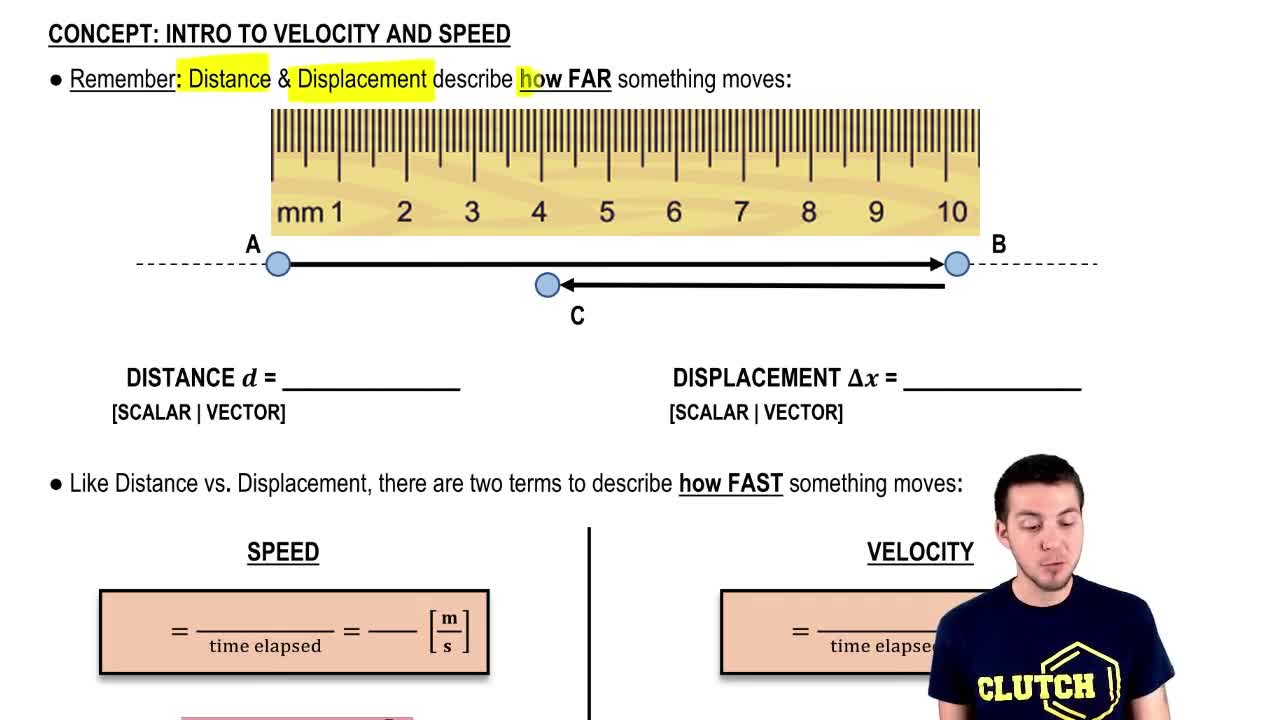
Intro to Velocity and Speed
30128
views
763
rank
11
comments
VideoThumbView.guidedCourse
01:21
Baseball Pitch
16470
views
471
rank
9
comments
Termini in questo insieme (20)
Nascondere definizioni
What does it mean that motion is relative?
Motion is described relative to a reference point; for example, your motion relative to Earth differs from your motion relative to the Sun.
How is speed defined?
Speed
is the distance covered per amount of travel time, typically measured in meters per second.
What is the formula for average speed?
Average speed = total distance / total travel time.
What is instantaneous speed?
The speed of an object at any specific instant, such as the speed shown on a car's speedometer.
How is velocity different from speed?
Velocity is
speed with direction
, making it a vector quantity.
What conditions define constant velocity?
Constant velocity means constant speed and constant direction (straight-line motion with no acceleration).
How is acceleration defined?
Acceleration is the rate at which velocity changes over time, including changes in speed or direction.
What is the unit of acceleration?
The unit of acceleration is velocity unit divided by time unit, e.g., meters per second squared (m/s²).
Can an object accelerating have constant speed?
Yes, if the object changes direction while maintaining speed, it is accelerating.
What did Galileo discover about acceleration on inclined planes?
Steeper inclines cause greater acceleration; vertical incline acceleration equals free-fall acceleration.
What is free fall?
Free fall is motion under gravity alone, with no air resistance.
What is the approximate acceleration due to gravity on Earth?
Approximately 10 meters per second squared (10 m/s²).
How does velocity change during free fall starting from rest?
Velocity increases by about 10 m/s every second (e.g., 10 m/s after 1 s, 20 m/s after 2 s).
How far does a freely falling object fall after 1 second starting from rest?
It falls about 5 meters after 1 second.
How far does a freely falling object fall after 4 seconds starting from rest?
It falls about 80 meters after 4 seconds.
What is the relationship between velocity and acceleration?
Velocity is the rate of change of position; acceleration is the rate of change of velocity.
How do velocity vectors combine when affected by wind?
Vectors combine using the parallelogram rule to find resultant velocity and direction.
What happens to the velocity of an airplane blown off course by a crosswind?
The airplane's velocity vector is the vector sum of its airspeed and the crosswind speed, changing its speed and direction.
How do you find the resultant velocity when running in rain falling vertically?
Combine horizontal running speed and vertical rain speed vectors using the parallelogram rule to find the resultant velocity and angle.
Why is acceleration considered a vector quantity?
Because it involves changes in both magnitude and direction of velocity.
 IndietroIndietro
 07:33
07:33