

Ch. 18 - Kinetic Theory of Gases
Giancoli Douglas - Physics for Scientists and Engineers 5th edition
Giancoli Douglas5th editionPhysics for Scientists and EngineersISBN: 9780137488179Non è quello che usi tu?Cambia libro di testo
Capitolo 18, Problema 7a

A 1.0-mol sample of helium gas has a temperature of 18°C. What is the total kinetic energy of all the gas atoms in the sample?

Guida verificata passo dopo passo
1
Convert the given temperature from Celsius to Kelvin using the formula: \( T(K) = T(°C) + 273.15 \). For this problem, \( T = 18 + 273.15 \).
Recall the formula for the total kinetic energy of an ideal gas: \( KE_{total} = \frac{3}{2} nRT \), where \( n \) is the number of moles, \( R \) is the ideal gas constant (8.314 J/(mol·K)), and \( T \) is the temperature in Kelvin.
Substitute the given values into the formula: \( n = 1.0 \) mol, \( R = 8.314 \) J/(mol·K), and \( T \) (calculated in step 1). The equation becomes \( KE_{total} = \frac{3}{2} (1.0)(8.314)(T) \).
Simplify the expression by multiplying the constants \( \frac{3}{2} \times 8.314 \) and then multiplying by the temperature \( T \) in Kelvin.
The result of the calculation will give the total kinetic energy of all the gas atoms in the sample, expressed in joules (J).

Risposta video verificata per un problema simile:

Questa soluzione video è stata consigliata dai nostri tutor come utile per risolvere questo problema.
Durata del video:
4m

Concetti chiave

Ecco i concetti essenziali che devi comprendere per rispondere correttamente alla domanda.

Kinetic Energy of Gases

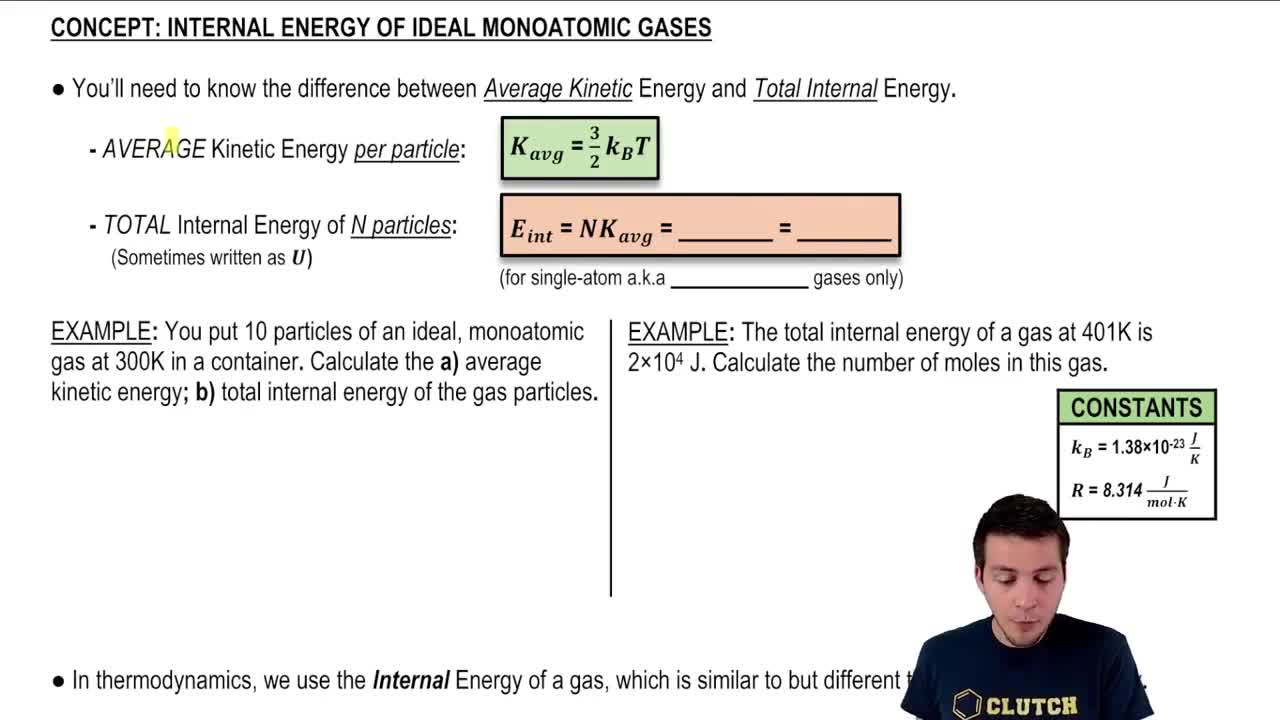
The kinetic energy of gas particles is directly related to their temperature. For an ideal gas, the average kinetic energy per particle can be calculated using the formula KE = (3/2)kT, where k is the Boltzmann constant and T is the temperature in Kelvin. This relationship indicates that as temperature increases, the kinetic energy of the gas particles also increases.
Video consigliato:
Percorso guidato
06:12
Internal Energy of Ideal Monoatomic Gases

Ideal Gas Law

The Ideal Gas Law, represented as PV = nRT, relates the pressure (P), volume (V), and temperature (T) of an ideal gas to the number of moles (n) and the ideal gas constant (R). While this law is not directly used to calculate kinetic energy, it provides a framework for understanding the behavior of gases under various conditions, which is essential for thermodynamic calculations.
Video consigliato:
Percorso guidato
07:21
Ideal Gases and the Ideal Gas Law

Molar Mass and Moles

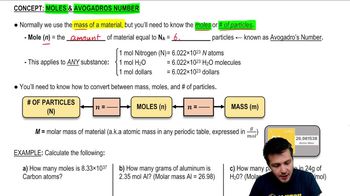
Molar mass is the mass of one mole of a substance, typically expressed in grams per mole. In this question, the sample of helium gas is given as 1.0 mol. Understanding moles is crucial for calculating the total kinetic energy, as it allows us to determine the total number of gas atoms and subsequently apply the kinetic energy formula to find the total energy of the sample.
Video consigliato:
Percorso guidato
07:19
Moles & Avogadro's Number