Ch. 19 - Heat and the First Law of Thermodynamics
Giancoli Douglas - Physics for Scientists and Engineers 5th edition
Giancoli Douglas5th editionPhysics for Scientists and EngineersISBN: 9780137488179Non è quello che usi tu?Cambia libro di testo
Capitolo 19, Problema 38b

A 1.0-L volume of air initially at 3.5 atm of (gauge)pressure is allowed to expand isothermally until the (gauge) pressure is 1.0 atm. It is then compressed at constant pressure to its initial volume, and lastly is brought back to its original pressure by heating at constant volume. How much work does the 1.0 L of air do in this process?

Guida verificata passo dopo passo
1
Step 1: Understand the problem and identify the process. The problem involves three thermodynamic processes: (1) isothermal expansion, (2) isobaric compression, and (3) isochoric heating. The goal is to calculate the total work done by the air during these processes.
Step 2: Write the formula for work done during isothermal expansion. For an isothermal process, the work done is given by: W=nRTln(PiPf), where n is the number of moles, R is the gas constant, T is the temperature, and Pi and Pf are the initial and final pressures, respectively. Use the given pressures and assume the temperature remains constant.
Step 3: Calculate the work done during the isobaric compression. For an isobaric process, the work done is given by: W=Pf⋅(Vf-Vi), where Pf is the constant pressure, and Vi and Vf are the initial and final volumes. Use the given data to calculate the change in volume during this step.
Step 4: Note that no work is done during the isochoric heating process. In an isochoric process, the volume remains constant, so the work done is zero: W=0. This simplifies the calculation for this step.
Step 5: Add the work contributions from all three processes. The total work done by the air is the sum of the work done during the isothermal expansion, the isobaric compression, and the isochoric heating. Use the results from Steps 2, 3, and 4 to find the total work done.

Risposta video verificata per un problema simile:

Questa soluzione video è stata consigliata dai nostri tutor come utile per risolvere questo problema.
Durata del video:
12m

Concetti chiave

Ecco i concetti essenziali che devi comprendere per rispondere correttamente alla domanda.

Isothermal Process

An isothermal process occurs when a system undergoes a change at a constant temperature. In the context of gases, this means that the internal energy remains constant, and any heat added to the system is used to do work. For an ideal gas, the work done during an isothermal expansion can be calculated using the formula W = nRT ln(Vf/Vi), where Vf and Vi are the final and initial volumes, respectively.
Video consigliato:
Percorso guidato
06:13
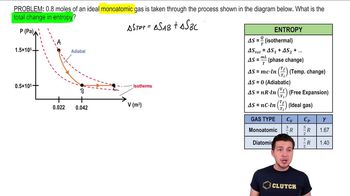
Entropy & Ideal Gas Processes

Work Done by a Gas

The work done by a gas during expansion or compression is defined as the product of pressure and the change in volume. For a constant pressure process, the work can be calculated using W = PΔV, where ΔV is the change in volume. In the case of isothermal expansion and compression, the work done can vary significantly depending on the initial and final pressures and volumes.
Video consigliato:
Percorso guidato
03:47
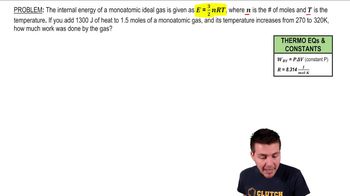
Calculating Work Done on Monoatomic Gas

First Law of Thermodynamics

The First Law of Thermodynamics states that energy cannot be created or destroyed, only transformed from one form to another. In thermodynamic processes, this law can be expressed as ΔU = Q - W, where ΔU is the change in internal energy, Q is the heat added to the system, and W is the work done by the system. Understanding this principle is crucial for analyzing energy transfers in the described process.
Video consigliato:
Percorso guidato
08:04
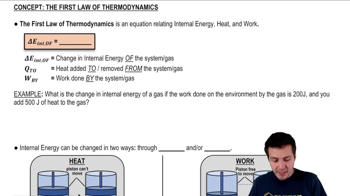
The First Law of Thermodynamics