Ch 19: Work, Heat, and the First Law of Thermodynamics
Knight Calc - Physics for Scientists and Engineers 5th Edition
Knight Calc5th EditionPhysics for Scientists and EngineersISBN: 9780137344796Non è quello che usi tu?Cambia libro di testo
Capitolo 19, Problema 57b

5.0 g of nitrogen gas at 20°C and an initial pressure of 3.0 atm undergo an isobaric expansion until the volume has tripled. How much heat energy is transferred to the gas to cause this expansion?

Guida verificata passo dopo passo
1
Determine the number of moles of nitrogen gas using the ideal gas law: \( PV = nRT \). Rearrange to solve for \( n \): \( n = \frac{PV}{RT} \). Use the given pressure \( P = 3.0 \; \text{atm} \), the initial temperature \( T = 20^{\circ}C = 293 \; \text{K} \), and the gas constant \( R = 0.0821 \; \text{L·atm/(mol·K)} \). Convert the mass of nitrogen gas (5.0 g) to moles if needed.
Recognize that the process is isobaric (constant pressure). For an isobaric process, the heat energy transferred \( Q \) is given by \( Q = nC_p\Delta T \), where \( C_p \) is the molar specific heat capacity at constant pressure for nitrogen gas (\( C_p = 29.1 \; \text{J/(mol·K)} \) for diatomic gases like nitrogen).
Calculate the final temperature \( T_f \) after the volume has tripled. Since the process is isobaric, the relationship between volume and temperature is \( \frac{V_f}{V_i} = \frac{T_f}{T_i} \). Use \( V_f = 3V_i \) and solve for \( T_f \): \( T_f = 3T_i \).
Determine the temperature change \( \Delta T \) using \( \Delta T = T_f - T_i \). Substitute the initial temperature \( T_i = 293 \; \text{K} \) and the calculated \( T_f \).
Substitute the values of \( n \), \( C_p \), and \( \Delta T \) into the equation \( Q = nC_p\Delta T \) to calculate the heat energy transferred to the gas during the expansion.

Risposta video verificata per un problema simile:

Questa soluzione video è stata consigliata dai nostri tutor come utile per risolvere questo problema.
Durata del video:
6m

Concetti chiave

Ecco i concetti essenziali che devi comprendere per rispondere correttamente alla domanda.

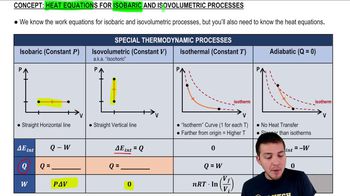
Isobaric Process

An isobaric process is a thermodynamic process in which the pressure remains constant while the volume and temperature of the gas change. In this scenario, as the nitrogen gas expands, it does so at a constant pressure of 3.0 atm, which simplifies the calculations for heat transfer since the pressure does not vary.
Video consigliato:
Percorso guidato
06:44
Heat Equations for Isobaric & Isovolumetric Processes

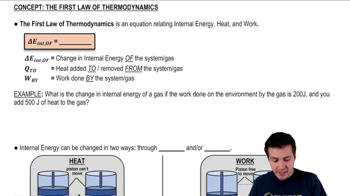
First Law of Thermodynamics

The First Law of Thermodynamics states that the change in internal energy of a system is equal to the heat added to the system minus the work done by the system. In the context of the isobaric expansion, the heat energy transferred to the gas can be calculated by considering both the work done during the expansion and the change in internal energy.
Video consigliato:
Percorso guidato
08:04
The First Law of Thermodynamics

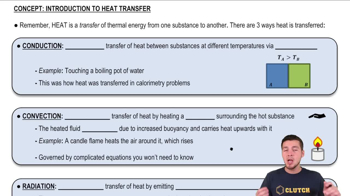
Heat Transfer in Gases

In an isobaric process, the heat transfer (Q) can be calculated using the formula Q = nCpΔT, where n is the number of moles, Cp is the specific heat capacity at constant pressure, and ΔT is the change in temperature. This relationship is crucial for determining how much heat energy is required to achieve the desired expansion of the gas.
Video consigliato:
Percorso guidato
05:14
Overview of Heat Transfer