Ch 19: Work, Heat, and the First Law of Thermodynamics
Knight Calc - Physics for Scientists and Engineers 5th Edition
Knight Calc5th EditionPhysics for Scientists and EngineersISBN: 9780137344796Non è quello che usi tu?Cambia libro di testo
Capitolo 19, Problema 43

512 g of an unknown metal at a temperature of 15°C is dropped into a 100 g aluminum container holding 325 g of water at 98°C. A short time later, the container of water and metal stabilizes at a new temperature of 78°C. Identify the metal.

Guida verificata passo dopo passo
1
Determine the heat gained or lost by each component (metal, water, and aluminum container) using the formula for heat transfer: Q = mc∆T, where Q is the heat, m is the mass, c is the specific heat capacity, and ∆T is the change in temperature.
Write the heat transfer equation for the system. Since the system is isolated, the heat lost by the water and aluminum container equals the heat gained by the unknown metal: -(Qwater + Qaluminum) = Qmetal.
Substitute the known values into the heat transfer formula for each component. For water: Qwater = mwatercwater(Tfinal - Tinitial). For aluminum: Qaluminum = maluminumcaluminum(Tfinal - Tinitial). For the metal: Qmetal = mmetalcmetal(Tfinal - Tinitial).
Rearrange the equation to solve for the specific heat capacity of the unknown metal, cmetal. Use the relationship: cmetal = rac{- (Qwater + Qaluminum)}{mmetal(Tfinal - Tinitial)}.
Compare the calculated specific heat capacity of the unknown metal to a table of known specific heat capacities to identify the metal.

Risposta video verificata per un problema simile:

Questa soluzione video è stata consigliata dai nostri tutor come utile per risolvere questo problema.
Durata del video:
5m

Concetti chiave

Ecco i concetti essenziali che devi comprendere per rispondere correttamente alla domanda.

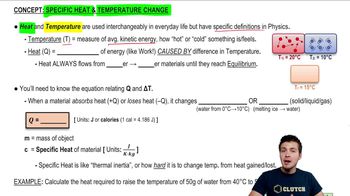
Specific Heat Capacity

Specific heat capacity is the amount of heat required to raise the temperature of a unit mass of a substance by one degree Celsius. It is a crucial property in thermal energy calculations, as different materials absorb and release heat at different rates. In this problem, knowing the specific heat capacities of aluminum, water, and the unknown metal allows us to set up equations to find the metal's identity based on the heat transfer involved.
Video consigliato:
Percorso guidato
06:50
Specific Heat & Temperature Changes

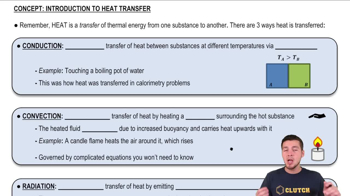
Heat Transfer and Equilibrium

Heat transfer occurs when thermal energy moves from a hotter object to a cooler one until thermal equilibrium is reached, meaning they stabilize at the same temperature. In this scenario, the heat lost by the water and aluminum container equals the heat gained by the unknown metal. This principle is essential for solving the problem, as it allows us to apply the conservation of energy to find the specific heat of the metal.
Video consigliato:
Percorso guidato
05:14
Overview of Heat Transfer

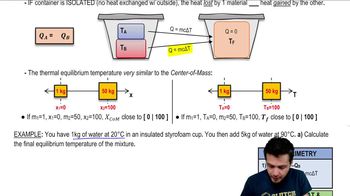
Calorimetry

Calorimetry is the science of measuring the heat of chemical reactions or physical changes, as well as heat capacity. In this context, it involves calculating the heat exchanged between the metal, water, and aluminum container to determine the unknown metal's specific heat. By using the formula Q = mcΔT, where Q is heat, m is mass, c is specific heat, and ΔT is the change in temperature, we can derive the necessary equations to identify the metal.
Video consigliato:
Percorso guidato
06:53
Solving Calorimetry Problems
Pratica correlata
Domanda del libro di testo

A 6.0-cm-diameter cylinder of nitrogen gas has a 4.0-cm-thick movable copper piston. The cylinder is oriented vertically, as shown in FIGURE P19.49, and the air above the piston is evacuated. When the gas temperature is 20°C, the piston floats 20 cm above the bottom of the cylinder. What is the gas pressure?

1473
views
1
rank
Domanda del libro di testo

A 5.0 g ice cube at −20°C is in a rigid, sealed container from which all the air has been evacuated. How much heat is required to change this ice cube into steam at 200°C? Steam has cV = 1500 J/kg K and cP = 1960 J/kg K.

1233
views
Domanda del libro di testo

The burner on an electric stove has a power output of 2.0 kW. A 750 g stainless steel teakettle is filled with 20°C water and placed on the already hot burner. If it takes 3.0 min for the water to reach a boil, what volume of water, in cm3, was in the kettle? Stainless steel is mostly iron, so you can assume its specific heat is that of iron.

1396
views
Domanda del libro di testo

The beaker in FIGURE P19.45, with a thin metal bottom, is filled with 20 g of water at 20°C. It is brought into good thermal contact with a 4000 cm3 container holding 0.40 mol of a monatomic gas at 10 atm pressure. Both containers are well insulated from their surroundings. What is the gas pressure after a long time has elapsed? You can assume that the containers themselves are nearly massless and do not affect the outcome.

1202
views
Domanda del libro di testo

When air is inhaled, it quickly becomes saturated with water vapor as it passes through the moist airways. Consequently, an adult human exhales about 25 mg of evaporated water with each breath. Evaporation—a phase change—requires heat, and the heat energy is removed from your body. Evaporation is much like boiling, only water's heat of vaporization at 35°C is a somewhat larger 24×105 J/kg because at lower temperatures more energy is required to break the molecular bonds. At 12 breaths/min, on a dry day when the inhaled air has almost no water content, what is the body's rate of energy loss (in J/s) due to exhaled water? (For comparison, the energy loss from radiation, usually the largest loss on a cool day, is about 100 J/s.)

1078
views
Domanda del libro di testo

A typical nuclear reactor generates 1000 MW (1000 MJ/s) of electric energy. In doing so, it produces 2000 MW of 'waste heat' that must be removed from the reactor to keep it from melting down. Many reactors are sited next to large bodies of water so that they can use the water for cooling. Consider a reactor where the intake water is at 18°C. State regulations limit the temperature of the output water to 30°C so as not to harm aquatic organisms. How many liters of cooling water have to be pumped through the reactor each minute?

1929
views