Ch 19: Work, Heat, and the First Law of Thermodynamics
Knight Calc - Physics for Scientists and Engineers 5th Edition
Knight Calc5th EditionPhysics for Scientists and EngineersISBN: 9780137344796Non è quello che usi tu?Cambia libro di testo
Capitolo 19, Problema 28b

A container holds 1.0 g of oxygen at a pressure of 8.0 atm. How much will the temperature increase if this amount of heat energy is transferred to the gas at constant volume?

Guida verificata passo dopo passo
1
Step 1: Identify the given values and the formula to use. The problem involves heat transfer at constant volume, so we use the formula for heat transfer in an ideal gas: Q = nC_vΔT, where Q is the heat energy transferred, n is the number of moles of gas, C_v is the molar heat capacity at constant volume, and ΔT is the temperature change.
Step 2: Calculate the number of moles of oxygen gas. Use the molar mass of oxygen, which is approximately 32 g/mol. The number of moles is given by n = rac{m}{M}, where m is the mass of the gas (1.0 g) and M is the molar mass.
Step 3: Determine the molar heat capacity at constant volume, C_v. For diatomic gases like oxygen, C_v is approximately rac{5}{2}R, where R is the universal gas constant (8.314 J/(mol·K)).
Step 4: Rearrange the heat transfer formula to solve for the temperature change: ΔT = rac{Q}{nC_v}. Substitute the values of Q, n, and C_v into the equation.
Step 5: Perform the calculation to find ΔT. This will give the increase in temperature of the gas in Kelvin. Ensure the units are consistent throughout the calculation.

Risposta video verificata per un problema simile:

Questa soluzione video è stata consigliata dai nostri tutor come utile per risolvere questo problema.

Concetti chiave

Ecco i concetti essenziali che devi comprendere per rispondere correttamente alla domanda.

Ideal Gas Law

The Ideal Gas Law relates the pressure, volume, temperature, and number of moles of a gas through the equation PV = nRT. This law is fundamental in understanding how gases behave under various conditions, particularly when analyzing changes in temperature and pressure while keeping volume constant.
Video consigliato:
Percorso guidato
07:21
Ideal Gases and the Ideal Gas Law

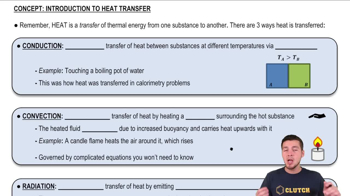
Heat Transfer and Internal Energy

Heat transfer refers to the energy exchanged between a system and its surroundings due to a temperature difference. In the context of gases, when heat is added at constant volume, it increases the internal energy of the gas, which is directly related to its temperature, as described by the first law of thermodynamics.
Video consigliato:
Percorso guidato
05:14
Overview of Heat Transfer

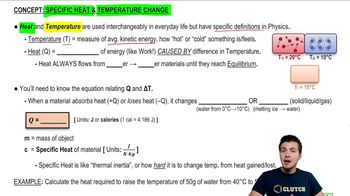
Specific Heat Capacity

Specific heat capacity is the amount of heat required to raise the temperature of a unit mass of a substance by one degree Celsius. For gases, this concept is crucial when calculating temperature changes resulting from heat transfer, as it determines how much the temperature will increase based on the amount of heat added.
Video consigliato:
Percorso guidato
06:50
Specific Heat & Temperature Changes