Ch 21: Heat Engines and Refrigerators
Knight Calc - Physics for Scientists and Engineers 5th Edition
Knight Calc5th EditionPhysics for Scientists and EngineersISBN: 9780137344796Non è quello che usi tu?Cambia libro di testo
Capitolo 21, Problema 63b

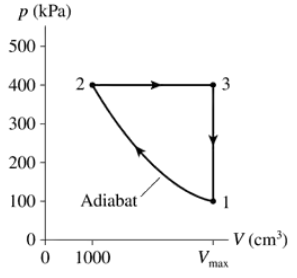
The heat engine shown in FIGURE P21.63 uses 0.020 mol of a diatomic gas as the working substance. Make a table that shows ∆Eth, Ws, and Q for each of the three processes.

Guida verificata passo dopo passo
1
Step 1: Identify the three processes in the heat engine cycle from the graph. The processes are: (1 → 2) adiabatic compression, (2 → 3) isobaric expansion, and (3 → 1) isochoric cooling.
Step 2: For each process, calculate the change in internal energy (∆Eth) using the formula ∆Eth = n * Cv * ∆T, where n is the number of moles, Cv is the molar specific heat at constant volume for a diatomic gas, and ∆T is the change in temperature. Use the ideal gas law (PV = nRT) to find temperatures at each state.
Step 3: Calculate the work done (Ws) for each process. For the adiabatic process (1 → 2), use the formula Ws = (P2 * V2 - P1 * V1) / (γ - 1), where γ = Cp/Cv. For the isobaric process (2 → 3), use Ws = P * ∆V. For the isochoric process (3 → 1), Ws = 0 since volume does not change.
Step 4: Calculate the heat transfer (Q) for each process using the first law of thermodynamics: Q = ∆Eth + Ws. For the adiabatic process (1 → 2), Q = 0 since no heat is exchanged. For the isobaric and isochoric processes, use the calculated values of ∆Eth and Ws.
Step 5: Organize the results into a table with columns for each process (1 → 2, 2 → 3, 3 → 1) and rows for ∆Eth, Ws, and Q. Ensure all values are consistent with the calculations and the graph provided.

Concetti chiave

Ecco i concetti essenziali che devi comprendere per rispondere correttamente alla domanda.

First Law of Thermodynamics

The First Law of Thermodynamics states that energy cannot be created or destroyed, only transformed from one form to another. In the context of a heat engine, this principle relates the change in internal energy (∆E_th) to the work done by the system (W_s) and the heat added to the system (Q) through the equation ∆E_th = Q - W_s.
Video consigliato:
Percorso guidato
08:04
The First Law of Thermodynamics

Heat Transfer (Q)

Heat transfer (Q) refers to the energy exchanged between the system and its surroundings due to a temperature difference. In a heat engine, Q is the heat absorbed from the hot reservoir during the heating process, which is essential for performing work and changing the internal energy of the gas.
Video consigliato:
Percorso guidato
05:14
Overview of Heat Transfer

Work Done by the System (W_s)

Work done by the system (W_s) is the energy transferred when the gas expands or compresses against an external pressure. In the context of the heat engine cycle shown in the diagram, W_s can be calculated during the expansion and compression processes, which are critical for understanding the engine's efficiency and performance.
Video consigliato:
Percorso guidato
05:58
Work Done By Springs
Pratica correlata
Domanda del libro di testo

A heat engine uses a diatomic gas that follows the pV cycle in FIGURE P21.59. Determine the pressure, volume, and temperature at point 2.

260
views

Domanda del libro di testo

A heat engine with 0.20 mol of a monatomic ideal gas initially fills a 2000 cm³ cylinder at 600 K. The gas goes through the following closed cycle: Isothermal expansion to 4000 cm³. Isochoric cooling to 300 K. Isothermal compression to 2000 cm³. Isochoric heating to 600 K. How much work does this engine do per cycle and what is its thermal efficiency?

1407
views
Domanda del libro di testo

100 mL of water at 15℃ is placed in the freezer compartment of a refrigerator with a coefficient of performance of 4.0. How much heat energy is exhausted into the room as the water is changed to ice at -15℃?

1865
views
Domanda del libro di testo

The heat engine shown in FIGURE P21.62 uses 2.0 mol of a monatomic gas as the working substance. Determine T1, T2 and T3.

284
views
Domanda del libro di testo

FIGURE CP21.70 shows two insulated compartments separated by a thin wall. The left side contains 0.060 mol of helium at an initial temperature of 600 K and the right side contains 0.030 mol of helium at an initial temperature of 300 K. The compartment on the right is attached to a vertical cylinder, above which the air pressure is 1.0 atm. A 10-cm-diameter, 2.0 kg piston can slide without friction up and down the cylinder. Neither the cylinder diameter nor the volumes of the compartments are known. How much heat is transferred from the left side to the right side?

246
views
Domanda del libro di testo

The heat engine shown in FIGURE P21.62 uses 2.0 mol of a monatomic gas as the working substance. Make a table that shows ∆Eth, Ws, and Q for each of the three processes.

1423
views