Ch 15: Mechanical Waves
Young & Freedman Calc - University Physics 14th Edition
Young & Freedman Calc14th EditionUniversity PhysicsISBN: 9780321973610Non è quello che usi tu?Cambia libro di testo
Capitolo 15, Problema 1

The speed of sound in air at 20°C is 344 m/s. (a) What is the wavelength of a sound wave with a frequency of 784 Hz, corresponding to the note G5 on a piano, and how many milliseconds does each vibration take? (b) What is the wavelength of a sound wave one octave higher (twice the frequency) than the note in part (a)?

Guida verificata passo dopo passo
1
Step 1: Understand the relationship between speed, frequency, and wavelength. The formula to use is: v=f×λ, where v is the speed of sound, f is the frequency, and λ is the wavelength.
Step 2: For part (a), use the given frequency of 784 Hz and the speed of sound 344 m/s to find the wavelength. Rearrange the formula to solve for wavelength: λ=vf. Substitute the values into the equation.
Step 3: Calculate the time period of each vibration, which is the reciprocal of the frequency. Use the formula: T=1f. Convert the time period from seconds to milliseconds by multiplying by 1000.
Step 4: For part (b), determine the frequency of the sound wave one octave higher than 784 Hz. An octave higher means the frequency is doubled, so the new frequency is 784 Hz * 2.
Step 5: Use the new frequency from step 4 and the speed of sound to find the wavelength of the sound wave one octave higher. Again, use the formula: λ=vf and substitute the new frequency value.

Risposta video verificata per un problema simile:

Questa soluzione video è stata consigliata dai nostri tutor come utile per risolvere questo problema.
Durata del video:
4m

Concetti chiave

Ecco i concetti essenziali che devi comprendere per rispondere correttamente alla domanda.

Speed of Sound

The speed of sound in air is the rate at which sound waves travel through the medium. At 20°C, this speed is approximately 344 m/s. It is influenced by factors such as temperature, humidity, and air pressure. Understanding this concept is crucial for calculating the wavelength of sound waves using the formula: speed = frequency × wavelength.
Video consigliato:
Percorso guidato
05:17
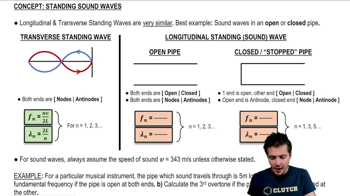
Standing Sound Waves

Frequency

Frequency refers to the number of oscillations or vibrations a wave undergoes per second, measured in Hertz (Hz). In this question, the frequency of the sound wave is given as 784 Hz, which corresponds to the musical note G5. Frequency is essential for determining the wavelength and the time period of each vibration using the relationship: time period = 1/frequency.
Video consigliato:
Percorso guidato
05:08
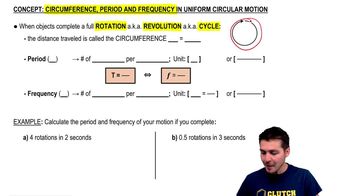
Circumference, Period, and Frequency in UCM

Wavelength

Wavelength is the distance between consecutive peaks or troughs of a wave, typically measured in meters. It is calculated using the formula: wavelength = speed of sound / frequency. Understanding wavelength is vital for solving both parts of the question, as it helps determine the spatial characteristics of sound waves at different frequencies.
Video consigliato:
Percorso guidato
05:42
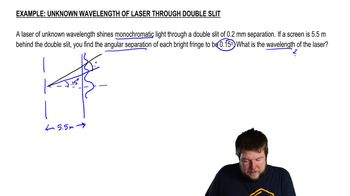
Unknown Wavelength of Laser through Double Slit