Ch 18: Thermal Properties of Matter
Young & Freedman Calc - University Physics 14th Edition
Young & Freedman Calc14th EditionUniversity PhysicsISBN: 9780321973610Non è quello che usi tu?Cambia libro di testo
Capitolo 18, Problema 36a

Smoke particles in the air typically have masses of the order of 10−1610^{-16} kg. The Brownian motion (rapid, irregular movement) of these particles, resulting from collisions with air molecules, can be observed with a microscope. Find the root-mean-square speed of Brownian motion for a particle with a mass of 3.00×10−163.00\(\times\)10^{-16} kg in air at 300300 K.

Guida verificata passo dopo passo
1
Start by understanding the concept of root-mean-square speed, which is a measure of the average speed of particles in a gas. It is derived from the kinetic theory of gases.
Use the formula for root-mean-square speed: 3kTm, where k is the Boltzmann constant (1.38×10⁻²³J·K-1), T is the temperature in Kelvin, and m is the mass of the particle.
Substitute the given values into the formula: 3×1.38×10-23·3003.00×10-16.
Calculate the numerator: 3×1.38×10-23·300, which represents the product of three constants and the temperature.
Calculate the root-mean-square speed by taking the square root of the fraction obtained from the previous steps, which involves dividing the calculated numerator by the mass of the particle.

Risposta video verificata per un problema simile:

Questa soluzione video è stata consigliata dai nostri tutor come utile per risolvere questo problema.
Durata del video:
3m

Concetti chiave

Ecco i concetti essenziali che devi comprendere per rispondere correttamente alla domanda.

Brownian Motion

Brownian motion refers to the random movement of particles suspended in a fluid, resulting from collisions with fast-moving molecules in the fluid. This phenomenon is crucial for understanding the behavior of smoke particles in air, as it explains their rapid and irregular motion observed under a microscope.
Video consigliato:

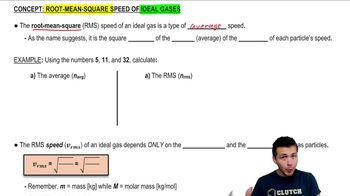
Root-Mean-Square Speed

The root-mean-square speed is a measure of the average speed of particles in a gas, derived from the kinetic theory of gases. It is calculated using the formula v_rms = sqrt((3kT)/m), where k is the Boltzmann constant, T is the temperature, and m is the mass of the particle. This concept helps quantify the speed of Brownian motion for smoke particles.
Video consigliato:
Percorso guidato
05:21
Root-Mean-Square Speed of Ideal Gases

Kinetic Theory of Gases

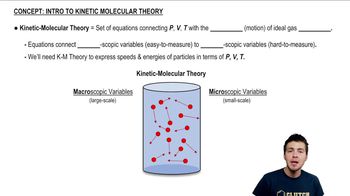
The kinetic theory of gases explains the macroscopic properties of gases by considering their molecular composition and motion. It provides the basis for calculating the root-mean-square speed, as it relates temperature and particle mass to the average kinetic energy, essential for understanding the dynamics of particles like those in Brownian motion.
Video consigliato:
Percorso guidato
01:50
Introduction to Kinetic-Molecular Theory
Pratica correlata
Domanda del libro di testo

Oxygen (O2) has a molar mass of 32.032.0 g/mol. How many oxygen molecules traveling at this speed are necessary to produce an average pressure of 11 atm?

2794
views
Domanda del libro di testo

How much heat does it take to increase the temperature of 1.801.80 mol of an ideal gas by 50.050.0 K near room temperature if the gas is held at constant volume and is diatomic?

2051
views
Domanda del libro di testo

How much heat does it take to increase the temperature of 1.801.80 mol of an ideal gas by 50.050.0 K near room temperature if the gas is held at constant volume and is monatomic?

1663
views
Domanda del libro di testo

Calculate the mean free path of air molecules at 3.50×10−133.50\(\times\)10^{-13} atm and 300300 K. (This pressure is readily attainable in the laboratory; see Exercise 18.2318.23.) As in Example 18.818.8, model the air molecules as spheres of radius 2.0×10−102.0\(\times\)10^{-10} m.

3012
views
Domanda del libro di testo

Compute the specific heat at constant volume of nitrogen (N2) gas, and compare it with the specific heat of liquid water. The molar mass of N2 is 28.028.0 g/mol.

2605
views
Domanda del libro di testo

At what temperature is the root-mean-square speed of nitrogen molecules equal to the root-mean-square speed of hydrogen molecules at 20.020.0°C? (Hint: Appendix D shows the molar mass (in g/mol) of each element under the chemical symbol for that element. The molar mass of H2 is twice the molar mass of hydrogen atoms, and similarly for N2.)

2219
views