The inverse sine function, denoted by \(\sin^{-1}\), is the inverse of the restricted sine function \(y=\sin x\) with domain \(-\frac{\pi}{2} \leq x \leq \frac{\pi}{2}\).
What is the domain and range of the inverse sine function?
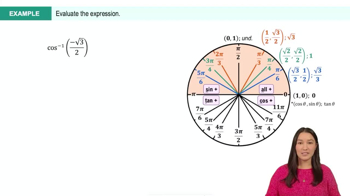
The inverse cosine function, denoted by \(\cos^{-1}\), is the inverse of the restricted cosine function \(y=\cos x\) with domain \(0 \leq x \leq \pi\).
What is the domain and range of the inverse cosine function?
Domain: \([-1,1]\), Range: \([0, \pi]\).
What is the inverse tangent function?
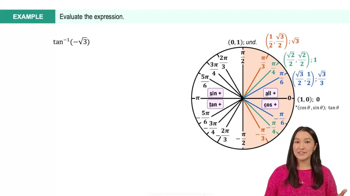
The inverse tangent function, denoted by \(\tan^{-1}\), is the inverse of the restricted tangent function \(y=\tan x\) with domain \(-\frac{\pi}{2} < x < \frac{\pi}{2}\).
What is the domain and range of the inverse tangent function?
Domain: \(\mathbb{R}\) (all real numbers), Range: \((-\frac{\pi}{2}, \frac{\pi}{2})\).
What is the property of the sine function and its inverse?
\(\sin(\sin^{-1} x) = x\) for every \(x \in [-1,1]\).
What is the property of the inverse sine function and sine?
\(\sin^{-1}(\sin x) = x\) for every \(x \in [-\frac{\pi}{2}, \frac{\pi}{2}]\).
What is the property of the cosine function and its inverse?
\(\cos(\cos^{-1} x) = x\) for every \(x \in [-1,1]\).
What is the property of the inverse cosine function and cosine?
\(\cos^{-1}(\cos x) = x\) for every \(x \in [0, \pi]\).
What is the property of the tangent function and its inverse?
\(\tan(\tan^{-1} x) = x\) for every real number \(x\).
What is the property of the inverse tangent function and tangent?
\(\tan^{-1}(\tan x) = x\) for every \(x \in (-\frac{\pi}{2}, \frac{\pi}{2})\).
How to evaluate \(\cot\left(\sin^{-1}\left(-\frac{1}{3}\right)\right)\)?
Use the right triangle approach: If \(\theta = \sin^{-1}(-\frac{1}{3})\), then \(\sin \theta = -\frac{1}{3}\). Find adjacent and hypotenuse to calculate \(\cot \theta\).
What is the range of the inverse sine function?
The range of \(\sin^{-1} x\) is \([-\frac{\pi}{2}, \frac{\pi}{2}]\).
What is the range of the inverse cosine function?
The range of \(\cos^{-1} x\) is \([0, \pi]\).
What is the range of the inverse tangent function?
The range of \(\tan^{-1} x\) is \((-\frac{\pi}{2}, \frac{\pi}{2})\).
Why are the domains of inverse trig functions restricted?
To make the trig functions one-to-one and thus invertible, their domains are restricted to intervals where they are monotonic.
What is the principal value branch for the inverse sine function?
The principal value branch for \(\sin^{-1} x\) is \([-\frac{\pi}{2}, \frac{\pi}{2}]\).
What is the principal value branch for the inverse cosine function?
The principal value branch for \(\cos^{-1} x\) is \([0, \pi]\).
What is the principal value branch for the inverse tangent function?
The principal value branch for \(\tan^{-1} x\) is \((-\frac{\pi}{2}, \frac{\pi}{2})\).
 Indietro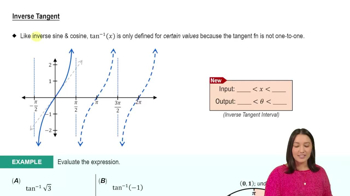
 3:17
3:17