Indietro

Precalculus: Tangent Lines, Limits, and Area Under Curves

I pulsanti di controllo sono stati cambiati in modalità "navigazione".
1/20
  • What does the slope of a tangent line to a curve at a point represent?

    The instantaneous rate of change of the function at that point.
  • What is a secant line and how is its slope interpreted?

    A secant line intersects the curve at two points; its slope is the average rate of change between those points.
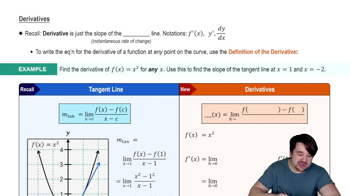
  • Define the derivative in terms of tangent lines.

    The derivative is the slope of the tangent line to the function at a specific point.
  • Formula for average rate of change between points \(x=a\) and \(x=b\)

    \(\frac{f(b)-f(a)}{b-a}\)
  • Formula for instantaneous rate of change (derivative) at \(x=a\)

    \(\lim_{h \to 0} \frac{f(a+h)-f(a)}{h}\)
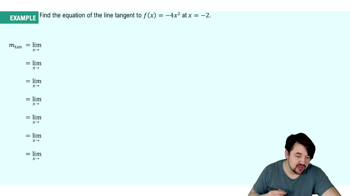
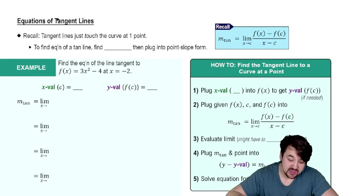
  • What is the point-slope form of a tangent line equation?

    \(y - f(a) = m(x - a)\), where m is the slope (derivative) at \(x=a\).
  • List the steps to find the equation of a tangent line at \(x=a\).

    1. Find the derivative \(f'(x)\).
    2. Evaluate \(f'(a)\) to get the slope.
    3. Find the point \((a, f(a))\).
    4. Use point-slope form to write the equation.
  • What does the derivative \(f'(x)\) represent?

    The instantaneous rate of change of the function at \(x\), or the slope of the tangent line.
  • Notation commonly used for derivatives.

    Leibniz notation: \(\frac{dy}{dx}\) or Lagrange notation: \(f'(x)\).
  • How can limits at infinity be described?

    They describe the behavior of a function as the input \(x\) grows very large positively or negatively.
  • Numerical approach to finding limits at infinity.

    Create a table of values for large positive or negative \(x\) and observe the function's values.
  • Algebraic method to find limits at infinity for rational functions.

    Divide each term by the highest power of \(x\) in the denominator and analyze the resulting expression.
  • Shortcut for limits at infinity comparing degrees of numerator and denominator:

    • If numerator degree < denominator degree: limit is 0.
    • If numerator degree > denominator degree: limit is infinity or negative infinity.
    • If degrees are equal: limit is ratio of leading coefficients.
  • Formula for the area of a rectangle.

    \(\text{Area} = \text{base} \times \text{height}\)
  • Formula for the area of a triangle.

    \(\text{Area} = \frac{1}{2} \times \text{base} \times \text{height}\)
  • How to approximate area under a curve using rectangles?

    Divide the region into rectangles and sum their areas using either left or right endpoint heights.
  • Difference between left and right endpoint approximations.

    Left endpoint uses the function value at the left corner of each subinterval; right endpoint uses the right corner.
  • Formula for approximating area under a curve using rectangles.

    \(\sum_{i=1}^n f(x_i^*) \Delta x\), where \(x_i^*\) is the chosen endpoint in each subinterval.
  • How to find the base (width) of each rectangle in area approximation?

    \(\Delta x = \frac{b - a}{n}\), where \([a,b]\) is the interval and \(n\) is the number of rectangles.
  • How to find the height of each rectangle in area approximation algebraically?

    Height is \(f(x_i^*)\), where \(x_i^*\) is the left or right endpoint of the subinterval.