Skip to main content
Precalculus
Il mio corso
Impara
Preparazione agli esami
AI Tutor
Guide di studio
Flashcard
Esplora
Prova l'app
Il mio corso
Impara
Preparazione agli esami
AI Tutor
Guide di studio
Flashcard
Esplora
Prova l'app
Indietro
Precalculus Unit Circle Basics
Puoi toccare per girare la carta.
What is the radius of the unit circle?
Puoi toccare per girare la carta.
👆
What is the radius of the unit circle?
The radius of the unit circle is \(1\).
Avanzamenti del tracciato
I pulsanti di controllo sono stati cambiati in modalità "navigazione".
1/19
Video consigliati
VideoThumbView.guidedCourse
06:11
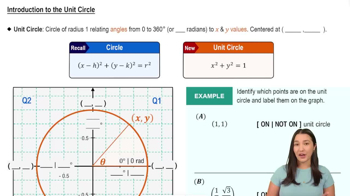
Introduction to the Unit Circle
2571
views
61
rank
1
comments
Termini in questo insieme (19)
Nascondere definizioni
What is the radius of the unit circle?
The radius of the unit circle is \(1\).
What are the coordinates of the point on the unit circle at 0 degrees?
The coordinates are \((1,0)\).
How is an angle measured on the unit circle?
An angle is measured from the positive x-axis, counterclockwise for positive angles.
What do the x- and y-coordinates represent on the unit circle?
The x-coordinate is
cosine
of the angle, and the y-coordinate is
sine
of the angle.
What is the sine of 90 degrees on the unit circle?
The sine of 90 degrees is \(1\).
What is the cosine of 180 degrees on the unit circle?
The cosine of 180 degrees is \(-1\).
What is the sine of 0 degrees on the unit circle?
The sine of 0 degrees is \(0\).
What is the cosine of 270 degrees on the unit circle?
The cosine of 270 degrees is \(0\).
How do you convert degrees to radians?
Multiply degrees by \(\frac{\pi}{180}\).
What is the radian measure of 180 degrees?
180 degrees equals \(\pi\) radians.
What is the radian measure of 90 degrees?
90 degrees equals \(\frac{\pi}{2}\) radians.
What is the sine and cosine of 45 degrees (or \(\frac{\pi}{4}\))?
Both sine and cosine are \(\frac{\sqrt{2}}{2}\).
What is the significance of the unit circle in trigonometry?
It defines sine and cosine values for all angles and helps understand periodic functions.
What are the coordinates of the point on the unit circle at 270 degrees?
The coordinates are \((0,-1)\).
How do you find the sine of an angle using the unit circle?
Find the y-coordinate of the point on the unit circle corresponding to that angle.
How do you find the cosine of an angle using the unit circle?
Find the x-coordinate of the point on the unit circle corresponding to that angle.
What is the cosine of 0 radians?
The cosine of 0 radians is \(1\).
What is the sine of \(\pi\) radians?
The sine of \(\pi\) radians is \(0\).
What is the relationship between the unit circle and the Pythagorean identity?
For any angle, \(\sin^2\theta + \cos^2\theta = 1\) holds true.
 IndietroIndietro
 06:11
