 Indietro
Chapter 5
 01:30

Termini in questo insieme (30)
Sensation is the process of detecting physical stimuli from the environment through sensory organs.
Perception is the brain's process of organizing and interpreting sensory information to give it meaning.
Virgil's case shows that sensation can occur without normal perception, highlighting that perception involves brain interpretation beyond raw sensory input.
The brain uses specialized pathways and processes to distinguish different types of sensory information both between senses and within a single sense.
Our senses have varying sensitivity levels, capable of detecting very faint stimuli near absolute thresholds.
Absolute threshold is the minimum stimulus intensity detectable 50% of the time; difference threshold is the smallest detectable difference between two stimuli.
Signal detection theory accounts for decision-making and noise, improving accuracy in detecting stimuli under uncertainty.
Methods include psychophysical scaling, sensory adaptation tests, and neuroimaging to assess sensory processing.
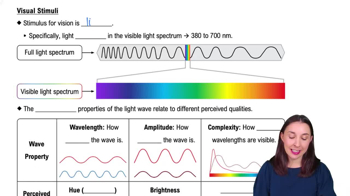
The stimulus for vision is light waves within the visible spectrum.
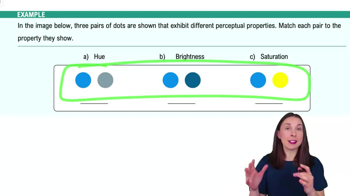
They include perception of color, depth, motion, and form, influenced by brain interpretation.
Cornea: focuses light; lens: adjusts focus; retina: contains photoreceptors; optic nerve: transmits signals to brain.
Glaucoma: optic nerve damage; cataracts: lens clouding; macular degeneration: retina deterioration.
Gestalt Psychology studies how we perceive whole forms rather than just a collection of parts.
Principles like proximity, similarity, continuity, and closure help organize visual elements into meaningful patterns.
Binocular cues use both eyes for depth (e.g., retinal disparity); monocular cues use one eye (e.g., size, texture gradient).
Examples include size constancy, shape constancy, and color constancy, where perception remains stable despite changes in sensory input.
Illusions reveal that perception is an active process where the brain can misinterpret sensory information.
The stimulus for hearing is sound waves, vibrations traveling through a medium.
Outer ear: collects sound; middle ear: transmits vibrations; inner ear: cochlea converts vibrations to neural signals.
Conduction deafness involves damage to the outer or middle ear; nerve deafness involves damage to the cochlea or auditory nerve.
Some types can be treated with hearing aids or cochlear implants depending on the cause.
The stimulus for taste is chemical molecules dissolved in saliva.
Basic tastes include sweet, sour, salty, bitter, and umami.
A supertaster has heightened taste sensitivity due to more taste buds.
The stimulus for smell is odorant molecules in the air.
The olfactory bulb processes smell information and sends it to the brain.
Basic skin senses include touch, pressure, temperature, and pain, each responding to different stimuli.
Pain is a complex sensory and emotional experience that signals potential harm.
Gate control theory suggests pain signals are modulated by spinal gates; neuromatrix theory emphasizes brain networks generating pain experience.
Kinesthesis senses body position and movement; equilibrium maintains balance through the vestibular system.