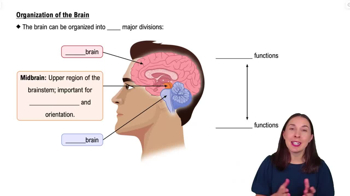
The "primitive brain" including the medulla (controls heart rate and breathing), pons (regulates sleep and arousal), and cerebellum (coordinates motor movements).
Reticular Activating System (RAS)
A network in the hindbrain responsible for arousal and attention regulation.
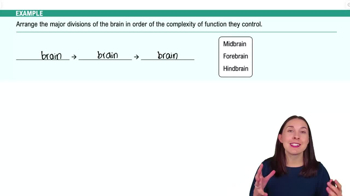
Midbrain
Brain region that controls movement and relays visual and auditory information.
Forebrain
Manages complex cognitive functions, sensory processing, and voluntary motor activities.
Limbic System
The emotional center of the brain including the amygdala (fear/aggression), hippocampus (long-term memory), hypothalamus (homeostasis), and thalamus (sensory relay).
Cerebral Cortex
The outermost layer of the brain, composed of grey matter, divided into two hemispheres connected by the corpus callosum, using contralateral control.
Frontal Lobe
Involved in planning, decision-making, motor control, contains the prefrontal cortex (executive functions) and Broca's area (speech production).
Parietal Lobe
Processes somatosensory information such as touch, pain, and temperature.
Temporal Lobe
Handles hearing, autobiographical memory, auditory cortex, and Wernicke's area for language comprehension.
Occipital Lobe
Responsible for vision processing and higher-order visual functions.
Neural Plasticity
The brain's ability to adapt through processes like myelination and synaptic pruning.
Intergenerational Trauma
Trauma and stress can alter brain structure and chemistry, passing vulnerabilities through environmental or epigenetic factors.
Phineas Gage Case
Damage to the left prefrontal cortex caused dramatic changes in behavior and personality, illustrating brain-behavior links.
Phrenology
A discredited pseudoscience claiming skull shape reflects brain traits.
CT Scan
Uses X-rays to create images of brain structure, useful for identifying tumors.
PET Scan
Tracks radioactive substances to show brain activity and blood flow.
 Indietro
 00:46