 Indietro
Introduction to Psychology Basics
 01:11

Termini in questo insieme (20)
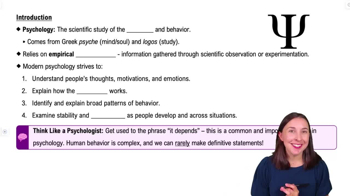
Psychology is the scientific study of behavior and mental processes.
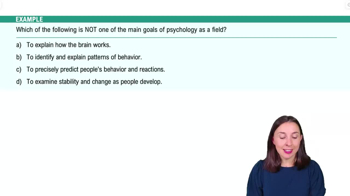
The main goals are to describe, explain, predict, and control behavior and mental processes.
Behavior refers to observable actions, while mental processes are internal experiences like thoughts and feelings.
Structuralism focused on breaking down mental processes; functionalism emphasized the purpose of behavior and mental processes.
Introspection, which involves examining one's own conscious thoughts and feelings.
Wilhelm Wundt is often called the father of psychology for establishing the first psychology lab.
It focuses on observable behavior and how it is learned through interaction with the environment.
A learning process where a neutral stimulus becomes associated with a meaningful stimulus, eliciting a conditioned response.
The cognitive perspective studies mental processes like memory, thinking, problem-solving, and language.
It examines how brain structures, chemicals, and genetics influence behavior and mental processes.
The humanistic perspective emphasizes personal growth, free will, and self-actualization.
Psychologists study, assess, and treat mental processes and behavior, often through research or therapy.
An experiment tests hypotheses by manipulating variables to determine cause and effect relationships.
The independent variable is manipulated; the dependent variable is measured for changes.
A testable prediction about the relationship between two or more variables.
Ethics protect participants' rights and well-being during research.
Psychiatrists are medical doctors who can prescribe medication; psychologists typically provide therapy and research.
Observing behavior in its natural environment without interference.
To conduct an in-depth analysis of an individual or group to explore rare or complex phenomena.
The unconscious contains thoughts and memories outside conscious awareness that influence behavior.