 Indietro
Introduction to Psychology: Consciousness and Sleep
 00:11

Termini in questo insieme (27)
The circadian rhythm is the cyclical biological changes that occur on a 24-hour basis, including hormone release and body temperature, regulated by the suprachiasmatic nucleus (SCN) in the hypothalamus.
Sleep pressure is the increasing urge to sleep triggered by an increase in melatonin levels.
Chronotypes are individual preferences for sleep and wake times, such as early birds (morning types) and night owls (evening types).
Sleep deprivation can cause weight gain, depression, increased cardiovascular risk, and decreased immune function.
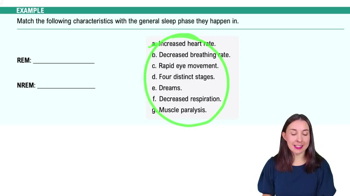
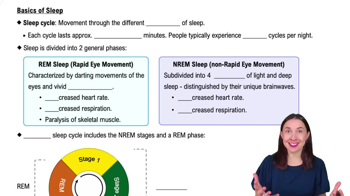
Sleep cycles through five stages: stages 1-4 are non-REM (NREM) sleep with no eye movements and fewer dreams; stage 5 is REM sleep with vivid dreams and rapid eye movements.
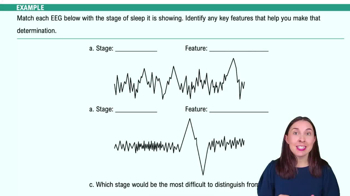
Stage 1 lasts 5-10 minutes, with brain waves slowing from beta to theta, hypnagogic imagery, and myoclonic jerks.
Stage 2 features further slowing of brain waves, sleep spindles, and K-complexes, making up about 65% of total sleep.
Stages 3 and 4 involve delta waves, are crucial for feeling rested, and are more prominent in children than elderly individuals.
REM sleep shows brain activity similar to wakefulness, longer duration as night progresses, vivid dreams, and muscle atonia (paralysis).
NREM dreams are shorter, thought-like, repetitive, and related to daily tasks; REM dreams are more emotional, illogical, prone to plot shifts, and biologically crucial.
Freud proposed that dreams transform sexual and aggressive instincts into symbols requiring interpretation, distinguishing manifest content (surface) from latent content (true meaning), often involving wish fulfilment.
This theory suggests dreams result from the brain's attempt to make sense of random neural signals originating in the pons during REM sleep.
Damage to the forebrain or parietal lobes can eliminate dreams completely, even if the pons are intact, suggesting the forebrain's key role in dreaming.
Dreams are meaningful products of cognitive capacities shaped by neurodevelopment and life experience; children's dreams are simpler, adults' are complex and bizarre.
Hallucinations are realistic perceptual experiences without external stimuli, involving brain activation similar to real sensory experiences, reported by 10-35% of people.
An OBE is the sensation that consciousness has left the body, often linked to unusual experiences, disorders, medication, or drugs.
Déjà vu is the feeling of reliving a new experience, possibly caused by excess dopamine, small temporal lobe seizures, or similarity to past experiences.
Hypnosis is an interpersonal situation where imaginative suggestions induce changes in consciousness; about 15-20% of people are highly suggestible.
Hypnosis does not produce a trance state, does not turn people into mindless robots, is not biologically like sleep, and people remain aware of surroundings.
The sociocognitive theory emphasizes attitudes and beliefs, while the dissociation theory suggests hypnosis separates normally integrated personality functions.
Abuse causes recurrent problems; dependence leads to impairment, tolerance, withdrawal symptoms, and cravings.
Sociocultural acceptance, personality traits, self-medication cycles, and genetics influence substance use and experiences.
Depressants reduce CNS activity; examples include alcohol and sedative-hypnotics, which calm or induce sleep.
Alcohol stimulates at low doses, depresses at high doses, affects females more heavily, and social expectations influence behavior.
Stimulants increase CNS activity; nicotine is highly addictive, cocaine is a powerful natural stimulant, and amphetamines have varied usage patterns.
Narcotics, derived from opium, relieve pain and induce sleep; heroin is the most abused opiate.
Psychedelics cause dramatic changes in perception and mood; marijuana and MDMA (ecstasy) are common examples.