 Indietro
Introduction to Psychology: Learning and Conditioning Concepts
 06:45

Termini in questo insieme (21)
Learning is a relatively permanent change in behavior or knowledge due to experience.
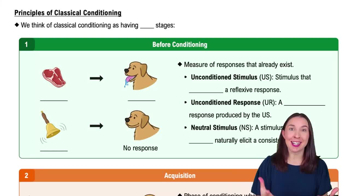
Classical conditioning is a learning process where a neutral stimulus becomes associated with an unconditioned stimulus to elicit a conditioned response.
An unconditioned stimulus naturally and automatically triggers a response without prior learning.
An unconditioned response is the automatic, natural reaction to an unconditioned stimulus.
A conditioned stimulus is a previously neutral stimulus that, after association with an unconditioned stimulus, triggers a conditioned response.
A conditioned response is the learned response to a conditioned stimulus.
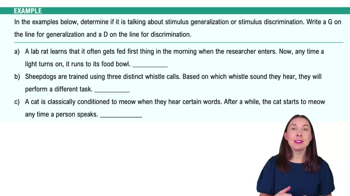
Stimulus generalization occurs when a response is triggered by stimuli similar to the conditioned stimulus.
Stimulus discrimination is the ability to distinguish between the conditioned stimulus and other similar stimuli.
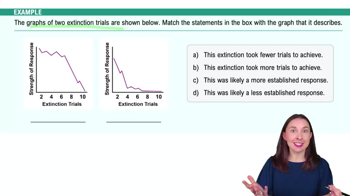
Extinction is the weakening of a conditioned response when the conditioned stimulus is repeatedly presented without the unconditioned stimulus.
Spontaneous recovery is the reappearance of a conditioned response after a rest period following extinction.
Operant conditioning is learning through consequences, where behavior is shaped by reinforcement or punishment.
Reinforcement increases the likelihood of a behavior by providing a positive stimulus or removing a negative one.
Punishment decreases the likelihood of a behavior by applying an adverse stimulus or removing a positive one.
Learned helplessness occurs when an individual learns to feel powerless to avoid negative situations after repeated failures.
Observational learning is acquiring new behaviors by watching and imitating others.
Taste aversions are learned avoidance of a particular food after a negative experience like illness.
Shaping is reinforcing successive approximations of a desired behavior to teach complex actions.
A neutral stimulus initially produces no specific response until it becomes a conditioned stimulus.
BF Skinner was a psychologist known for his work on operant conditioning and reinforcement.
Ivan Pavlov was a physiologist famous for discovering classical conditioning through his experiments with dogs.
Albert Bandura is known for his research on observational learning and the social learning theory.