 Indietro
Introduction to Psychology - Learning Chapter Review
 06:45

Termini in questo insieme (28)
Learning is a relatively permanent change in behavior or knowledge due to experience, distinct from maturation.
It means the change from learning lasts over time and is not just temporary.
Maturation is natural biological growth, while learning involves changes from experience.
Cognition refers to mental processes like thinking, memory, and problem-solving involved in learning.
John Watson, Ivan Pavlov, and B.F. Skinner are key early theorists.
Watson is known for behaviorism and the Little Albert experiment, demonstrating conditioned emotional responses.
An experiment where a baby was conditioned to fear a white rat by pairing it with a loud noise.
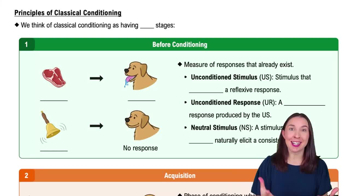
NS (Neutral Stimulus), UCS (Unconditioned Stimulus), UCR (Unconditioned Response), CS (Conditioned Stimulus), and CR (Conditioned Response).
An initially meaningless stimulus that does not trigger a response before conditioning.
A stimulus that naturally and automatically triggers a response without prior learning.
The natural, automatic reaction to the UCS.
A previously neutral stimulus that, after association with the UCS, triggers a conditioned response.
The learned response to the conditioned stimulus.
A learning process where behavior is shaped by consequences like reinforcement or punishment.
Adding a pleasant stimulus to increase a behavior.
Removing an unpleasant stimulus to increase a behavior.
Adding an unpleasant stimulus to decrease a behavior.
Removing a pleasant stimulus to decrease a behavior.
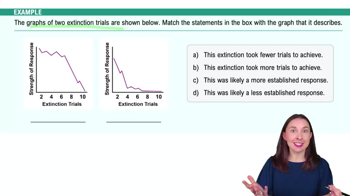
The weakening and eventual disappearance of a learned response when reinforcement stops.
Rats learned a maze without reinforcement, showing latent learning that appeared when motivated.
Learning that occurs but is not demonstrated until there is motivation to do so.
Chimps showed insight learning, solving problems suddenly without trial and error.
A sudden realization of a problem's solution without gradual trial and error.
A condition where an organism learns it has no control over negative events and stops trying to change the situation.
Learning by watching and imitating others' behavior.
Learning is acquiring knowledge, while performance is actually demonstrating the learned behavior.
Attention, Memory, Imitation, and Desire to perform the behavior.
Positive, helpful behaviors learned by observing others.