 Indietro
Introduction to Psychology: Learning Theories and Experiments
 06:45

Termini in questo insieme (20)
Learning is a relatively permanent change in behavior or knowledge due to experience, distinct from maturation.
Cognition refers to mental processes involved in acquiring knowledge and understanding through thought, experience, and the senses.
John Watson is known for the Little Albert experiment, demonstrating classical conditioning of fear in humans.
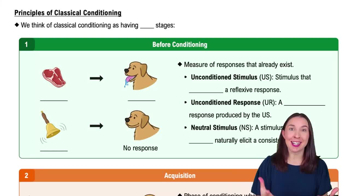
NS is a stimulus that initially produces no specific response before conditioning.
UCS naturally and automatically triggers a response without prior learning.
UCR is the unlearned, naturally occurring response to the UCS.
CS is a previously neutral stimulus that, after association with the UCS, triggers a conditioned response.
CR is the learned response to the previously neutral stimulus (CS).
Reinforcement increases the likelihood of a behavior; it can be positive (adding a stimulus) or negative (removing a stimulus).
Punishment decreases the likelihood of a behavior; it can be positive (adding a stimulus) or negative (removing a stimulus).
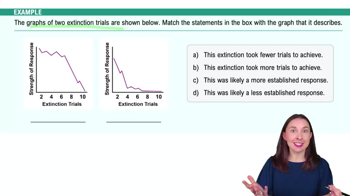
Extinction occurs when a behavior decreases because reinforcement is no longer given.
Tolman showed rats demonstrated latent learning by navigating a maze without reinforcement, learning was evident when a reward was introduced.
Latent learning is learning that occurs but is not immediately demonstrated in behavior until there is motivation to do so.
Kohler demonstrated insight learning where chimps suddenly solved problems without trial-and-error, showing understanding.
Insight learning is the sudden realization of a problem's solution without gradual shaping or reinforcement.
Learned helplessness occurs when an organism learns it has no control over negative outcomes, leading to passive behavior.
Observational learning is learning by watching others and imitating their behavior.
Learning is acquiring knowledge or behavior, while performance is the demonstration of that learning at a given time.
Prosocial behavior refers to positive, helpful actions learned through observing others.
Observational learning requires attention, memory, imitation, and desire to perform the behavior.