 Indietro
Lesson 10 Guided Learning Questions
 03:03

Termini in questo insieme (21)
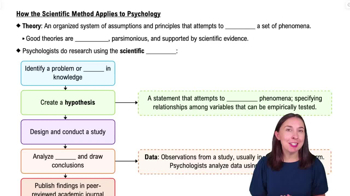
Constructs are general, abstract concepts about people that can't be directly counted or measured, such as love, mood, creativity, personality, intelligence, attention, self-esteem, conscientiousness, and motivation.
The independent variable is manipulated to cause change, while the dependent variable reflects or measures that change. Example: manipulating frustration (independent) to measure aggression (dependent).
The problem of defining vague concepts like love or intelligence scientifically. It requires objective measurement, falsifiability, converging evidence, public verification, and replication to solve.
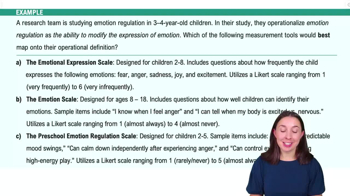
Operational definitions specify constructs as observable and measurable events, moving from abstract concepts to concrete measures, e.g., intelligence as a test score or aggression as number of punches.
1) Observation of behavior
2) Self-report
3) Aptitude and ability tests
4) Physiological measures
Good for generating hypotheses, studying rare cases, and easy data collection about behaviors.
Cannot reveal thoughts or feelings, selective attention issues, observer bias, reactivity (people act differently when watched), and resource limits.
Testimonials, surveys, questionnaires, interviews, MMPI, integrity tests, Thematic Apperception Test, Rorschach Inkblot Test, and polls like Gallup.
Low validity due to personal bias, focus on individual experience, vividness, and use as sales tools; not scientific.
Efficient data collection, hypothesis generation, tracking attitude changes, identifying specific traits, and learning about individuals.
Issues with honesty, motivation, mismatch between intentions and behavior, comprehension, and question framing effects.
Physical tests (strength, speed, agility) and mental tests (learning, memory, cognitive, emotional, social abilities).
Identify strengths and weaknesses, screen applicants; limited by validity concerns and high cost for well-validated tests.
Assess biological system function (heart rate, hormone levels, brain function); less useful for evaluating behavior and thinking.
Combining methods offsets individual limitations, provides converging evidence, and creates richer, more reliable data.
Reliability is consistency of measurement; the same results occur under similar conditions repeatedly.
Validity is how well a measure reflects the actual construct it intends to measure; requires reliability.
The principle that scientific concepts must be linked to observable, measurable operations to be public and testable.
No. Personal or intuitive definitions are not operational because they lack replicability; operational definitions vary in directness and can be multiple for one concept.
People have intuitive, everyday meanings for psychological terms that differ from technical definitions, causing misunderstanding of research.
Because psychology uses everyday words with preexisting meanings, people expect ultimate explanations, unlike in other sciences.