Skip to main content
Introduction to Psychology
Il mio corso
Impara
Preparazione agli esami
AI Tutor
Guide di studio
Flashcard
Esplora
Prova l'app
Il mio corso
Impara
Preparazione agli esami
AI Tutor
Guide di studio
Flashcard
Esplora
Prova l'app
Indietro
Lesson 8 Guided Learning Questions
Puoi toccare per girare la carta.
Why is our perception of reality personal?
Puoi toccare per girare la carta.
👆
Why is our perception of reality personal?
We see only one point of view at a time and interpret unclear things using past experiences, making beliefs subjective and personal.
Avanzamenti del tracciato
I pulsanti di controllo sono stati cambiati in modalità "navigazione".
1/25
Video consigliati
VideoThumbView.guidedCourse
03:03
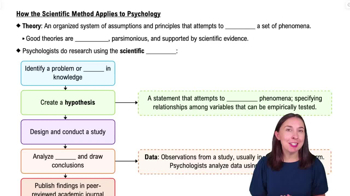
How the Scientific Method Applies to Psychology
1579
views
11
rank
VideoThumbView.guidedCourse
03:04
The Scientifc Method in Psychology Example 3
882
views
7
rank
VideoThumbView.guidedCourse
01:52
The Scientifc Method in Psychology Example 4
887
views
3
rank
Termini in questo insieme (25)
Nascondere definizioni
Why is our perception of reality personal?
We see only one point of view at a time and interpret unclear things using past experiences, making beliefs subjective and personal.
What are the goals of our personal belief system?
To help us find happiness, survive, maintain positive self-esteem, and feel control, even if beliefs are inaccurate.
Why can personal beliefs be wrong?
Because they are based on flawed observations, intuition, reasoning, emotions, biases, and confirmation bias.
What is the just-world hypothesis?
The belief that good things happen to good people and bad things happen to bad people.
What is the fundamental attribution error?
Blaming others' bad behavior on their character rather than their situation.
What is the self-serving bias?
Taking too much credit for our successes while blaming failures on external factors.
What is the availability heuristic?
Judging the likelihood of events based on how easily examples come to mind.
What is confirmation bias?
Noticing and remembering information that supports our existing beliefs.
How do emotions affect thinking?
Strong emotions can cause us to miss information, affect memory, and influence decision-making.
What is empirical testing?
Basing judgments on evidence and trial rather than intuition or opinion.
What is systematic testing?
Planning and ordering tests to efficiently rule out competing explanations.
What is objective evidence?
Evidence free from emotion and opinion, based on measurement with accepted tools.
What is 'The Human Problem' in science?
Scientists are human and subject to faulty reasoning; science uses methods to overcome this.
What are the key features of the scientific attitude?
Objectivity, open-mindedness, critical thinking, humility, and recognizing complexity and mistakes.
What is systematic empiricism?
Structured observation aimed at understanding how the world works, often theory-driven.
Why is publicly verifiable knowledge important?
It allows others to test, criticize, and replicate findings, ensuring reliability.
What is replication in science?
Repeating an experiment to see if the same results occur, confirming findings.
What is peer review?
Scientists critique research before publication to ensure quality and objectivity.
What defines a testable theory?
A theory with specific, observable implications that can be empirically tested and potentially falsified.
What is the difference between problems and mysteries in science?
Problems have knowable answers and can be tested; mysteries cannot yet be imagined or tested.
What is intuitive thinking (System 1)?
Fast, automatic, effortless, emotional, and associative thinking that operates unconsciously.
What is reasoned thinking (System 2)?
Slow, deliberate, controlled, effortful, and analytical thinking that is conscious.
What are benefits of intuitive thinking?
It is fast, efficient, supports automatic skills, quick social judgments, expertise, and creativity.
What are limitations of intuitive thinking?
It can cause biases, illusions, misjudgments, implicit prejudice, and poor predictions.
Why is psychology often in a no-win situation?
It challenges common sense and folk beliefs, leading to resistance and discomfort.
 IndietroIndietro
 03:03