 Indietro
Lesson 9 Guided Learning Questions
 03:03

Termini in questo insieme (27)
The incorrect belief that science provides quick answers to big questions, like a sudden moment of inspiration. In reality, science progresses slowly through small, testable questions.
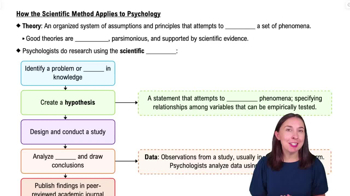
The forming and testing of scientific ideas (theories and hypotheses), which is a slow, methodical process essential for scientific progress.
Specific, testable predictions about observable changes in empirical studies, derived from observation or previous research.
An explanation for patterns found across multiple studies, formed when related hypotheses yield similar results.
Scientific ideas must connect to existing evidence and previous research; they cannot be based solely on intuition or opinion.
Scientific ideas must be testable and specific enough to be proven false by evidence, making them valuable and meaningful.
Because they make precise predictions that can be tested and potentially disproven, providing clearer evidence for or against the idea.
Yes, it limits science to empirically testable questions, excluding metaphysical or untestable topics.
Confidence in a scientific finding increases when different researchers, methods, and settings produce the same results.
Yes, because it prompts further research and theory revision, leading to better understanding.
Scientists share results publicly so others can replicate, critique, and build on them, ensuring quality and progress.
New theories must explain both new and existing facts, making science cumulative and connected to prior knowledge.
The Great-Leap model sees science as sudden breakthroughs; the Gradual-Synthesis model sees it as slow, incremental progress through many studies.
Because no single study proves anything; conclusions require converging evidence from many studies.
Through converging evidence from multiple studies with different methods and flaws pointing to the same conclusion.
Scientific knowledge advances through consensus built on many studies, not sudden breakthroughs.
A testable theory that is potentially falsifiable and can be empirically evaluated.
The requirement that scientific theories must make predictions that could be proven false by evidence.
Laypeople see theories as guesses; scientists see them as well-supported explanations that predict future results.
Hypotheses are specific predictions derived from broader, more general theories.
A good theory makes specific, falsifiable predictions; a bad theory is vague or unfalsifiable.
Because it is unfalsifiable and explains behavior only after the fact, hindering scientific progress.
Failure helps correct errors and refine theories, moving science closer to the truth.
The feeling that something is true without evidence; science rejects truthiness.
A social process of checks and balances where scientists cross-check and critique each other's work.
The tendency to favor evidence and interpretations that support one's own beliefs.
No, uncertainty exists mainly at the knowledge frontiers; many scientific facts are well established.