 Indietro
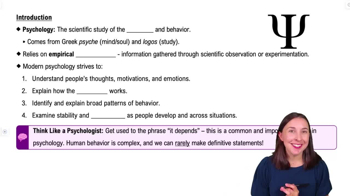
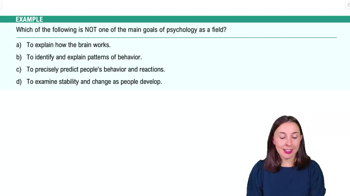
Major Psychological fields (from my notes from videos)
 01:11
01:11
Termini in questo insieme (29)
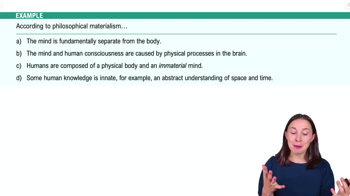
Philosophical dualism is the idea that the mind and body are separate and distinct entities.
Philosophical materialism holds that the mind is what the brain does; mental processes arise from physical brain activity.
Empiricism states people are born as blank slates (tabula rasa) and knowledge comes from experience.
Nativism argues that people are born with innate traits and knowledge, not just from experience.
Structuralism focuses on the basic elements of consciousness using introspection; founded by Wundt and Titchener.
Functionalism studies the purpose of behavior and consciousness, emphasizing why we do things; influenced by Darwin.
Psychoanalysis explores unconscious thoughts shaped by childhood trauma; founded by Freud using talk therapy.
Gestalt psychology states the whole is greater than the sum of its parts, focusing on perception and motion.
Behaviorism studies observable behavior using scientific methods; key figures include Watson, Skinner, and Pavlov.
Developmental psychology examines growth and changes across the lifespan; Piaget studied children's cognition.
Social psychology studies how social factors influence individual and group behavior, attitudes, and identity.
Humanistic psychology focuses on personal growth, self-actualization, and inherent goodness; Maslow and Rogers are key figures.
Cognitive psychology studies mental processes like memory, thinking, and language; sparked by the cognitive revolution.
Evolutionary psychology examines how psychological traits evolved through natural selection to solve adaptive problems.
Cultural psychology studies how culture influences behavior and mental processes, integrating anthropology and ecology.
Biological perspective focuses on the brain and nervous system's role in behavior; neuroscience formalized this in the 1990s.
Wilhelm Wundt is the father of modern psychology and founded structuralism, emphasizing introspection.
William James developed functionalism, focusing on the purpose of consciousness and behavior.
Classical conditioning is learning by association, famously demonstrated by Pavlov's dogs.
Operant conditioning involves learning through rewards and punishments; key figure is B.F. Skinner.
Maslow's hierarchy describes stages of human needs culminating in self-actualization.
Carl Rogers emphasized empathy, unconditional positive regard, and active listening in therapy.
Ulric Neisser is considered the father of cognitive psychology, focusing on mental processes.
Jean Piaget studied children's cognitive development and how they understand the world.
Kurt Lewin studied leadership and group dynamics in social psychology.
Solomon Asch researched conformity and first impressions, important in social psychology.
John Garcia showed biological preparedness in learning, such as rats associating nausea with taste.
Richard Shweder advocated studying diverse cultures beyond Western theories in cultural psychology.
Santiago Ramón y Cajal is the father of neuroscience, studying the brain's structure and function.