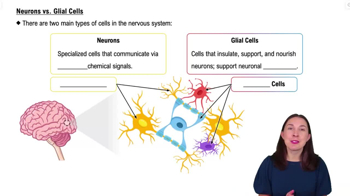
Neurons are nerve cells specialized in communicating with each other and serve as the building blocks of the nervous system.
What are the main components of a neuron?
The main components are the cell body (soma), dendrites (receive information), axon (transmits information), and axon terminal (releases neurotransmitters).
What is the function of dendrites?
Dendrites are branchlike extensions that receive information from other neurons.
What role do axons play in neural communication?
Axons transmit electrical signals away from the cell body to other neurons or muscles.
What is the synapse?
The synapse is the gap between neurons where neurotransmitters travel to transmit signals chemically.
What are glial cells and their functions?
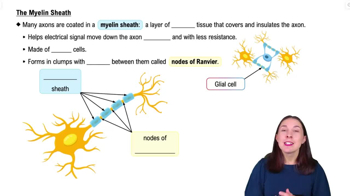
Glial cells support neurons by making myelin, feeding, and protecting them.
What is the myelin sheath and its importance?
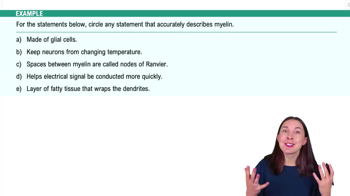
The myelin sheath is fatty insulation around axons that speeds up neural signals.
What happens in Multiple Sclerosis (MS)?
MS causes loss of myelin, leading to erratic and slowed neural signals.
Describe the resting potential of a neuron.
At resting potential, the neuron is polarized with a negative inside and positive outside, blocking sodium ions (\(Na^+\)).
What triggers an action potential?
A stimulus causes depolarization as \(Na^+\) rushes in, creating a brief electrical charge that travels down the axon.
What is the all-or-none law in neuron firing?
Neurons either fire at full intensity or not at all; frequency of firing encodes stimulus intensity.
What occurs during repolarization?
\(K^+\) ions flow out of the neuron to restore the negative internal charge.
What is the refractory period?
A brief time after firing when the neuron cannot fire again regardless of stimulation.
How do neurons communicate electrochemically?
Electrical signals trigger neurotransmitter release into the synapse, converting electrical signals into chemical messages.
What is the difference between excitatory and inhibitory messages?
Excitatory messages increase the likelihood a neuron will fire; inhibitory messages decrease it.
What are neurotransmitters?
Neurotransmitters are chemical messengers that influence mood, movement, sleep, learning, and memory.
What is reuptake in neurotransmission?
Reuptake is the recycling of excess neurotransmitters back into the presynaptic neuron.
What are agonists and antagonists?
Agonists mimic or enhance neurotransmitter effects; antagonists block or reduce them.
What is the role of glutamate and GABA?
Glutamate is the main excitatory neurotransmitter; GABA is the main inhibitory neurotransmitter in the CNS.
What functions does acetylcholine (ACh) serve?
ACh controls arousal, attention, memory, and sleep.
How does dopamine affect behavior?
Dopamine regulates pleasure, reward, voluntary movement, and attention.
What is serotonin's role?
Serotonin regulates mood, sleep-wake cycles, satiety, cognition, and pain perception.
What are SSRIs and their function?
Selective Serotonin Reuptake Inhibitors block serotonin reuptake to treat depression and anxiety disorders.
What are the main divisions of the nervous system?
The CNS includes brain and spinal cord; the PNS transmits info to/from CNS.
What is the somatic nervous system?
The somatic system transmits sensory info and controls skeletal muscles.
What does the autonomic nervous system regulate?
It regulates organs and glands, divided into sympathetic (stress response) and parasympathetic (rest and digest) divisions.
What are the main brain regions in the hindbrain?
The medulla (vital functions), pons (sleep/arousal), and cerebellum (motor coordination).
What is the limbic system responsible for?
The limbic system manages emotions and memory, including the amygdala, hippocampus, hypothalamus, and thalamus.
What functions are associated with the frontal lobe?
Planning, decision-making, motor control, and speech production (Broca's area).
What is neural plasticity?
The brain's ability to adapt through myelination and synaptic pruning.
 Indietro
 01:12