Indietro

PSYCH RESEARCH. METHODS #2

I pulsanti di controllo sono stati cambiati in modalità "navigazione".
1/29
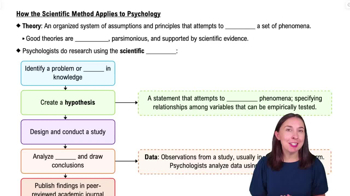
  • Why do we need research in psychology?

    Facilitated Communication - Assisting another to "type" messages.

  • Types of Research Questions


    To test assumptions, solve real-world problems, understand how things work, and move beyond common sense and anecdotal observations.

  • Population vs. Sample

    Population is the entire group of interest; Sample is a smaller group drawn from the population who participate in the study.
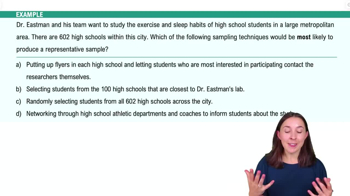
  • What is random selection?

    Choosing participants so every person in the population has an equal chance of being selected, ensuring generalizability.
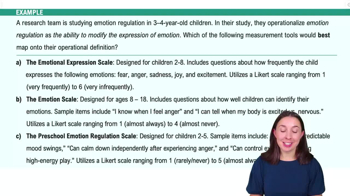
  • What is an operational definition?

    Translating a research question into specific, measurable procedures to observe and test variables.
  • Name three descriptive research methods.

    Naturalistic observation, case studies, and self-report measures/surveys.
  • What is internal validity?

    How well a study is conducted, ensuring the IV caused changes in the DV without confounds.
  • What is external validity?

    The extent to which study findings can be generalized to real-world settings.
  • Advantages of naturalistic observation

    High external validity, rich detailed data, and useful when lab studies are impractical.
  • Disadvantages of naturalistic observation

    Lack of control, time-consuming, observer bias, and no cause-effect conclusions.
  • What is a case study?

    An in-depth qualitative analysis of a single person or setting, often used for rare phenomena.
  • Advantages of case studies

    Provide rich, detailed data and can be the only method for studying rare cases.
  • Disadvantages of case studies

    Low external validity and potential researcher bias.
  • What are self-report methods?

    Collecting data by asking participants about their own behaviors, attitudes, or perceptions.
  • Common issues with surveys and questionnaires

    Careless responding, misunderstanding questions, response bias, and social desirability effects.
  • Difference between reliability and validity

    Reliability is consistency of measurement; Validity is how well a measure assesses what it claims to.
  • What is test-retest reliability?

    Consistency of a measure across time points, assessed by correlating scores from Time 1 and Time 2.
  • What is inter-rater reliability?

    Consistency of measurement across different raters, often measured by Cohen's kappa.
  • What does a correlation coefficient indicate?

    The strength and direction of a relationship between two variables, ranging from -1.0 to +1.0.
  • Why does correlation not imply causation?

    Because relationships can be due to A→B, B→A, or a third variable influencing both.
  • What is a confound variable?

    An outside factor that varies with the IV and provides an alternative explanation, threatening internal validity.
  • Key features of experimental method

    Manipulation of at least one variable (IV), measurement of another (DV), and random assignment to groups.
  • What is the independent variable (IV)?

    The variable manipulated by the researcher to observe its effect.
  • What is the dependent variable (DV)?

    The variable measured to assess the effect of the IV.
  • What is the expectancy effect?

    Changes in participant behavior caused by researcher expectations, minimized by double-blind designs.
  • What are demand characteristics?

    Cues that lead participants to guess the study purpose and alter their behavior accordingly.
  • What is the replication crisis?

    The difficulty in replicating many psychological studies, with an overall replication rate around 36%.
  • Ethical guidelines for human research

    Include informed consent, protection from harm, and use of deception only with debriefing.
  • What was unethical about the Tuskegee Syphilis study?

    Participants were not informed of their disease, were denied treatment, and many died or spread syphilis.