 Indietro
Introduction to Sociology: Demography and Urbanization Concepts
 02:24

Termini in questo insieme (27)
Demography is the study of population size, composition, and distribution, including changes due to births, deaths, and migration.
Fertility refers to the actual reproductive performance of an individual or population, often measured by birth rates.
The crude birth rate is the number of live births per 1,000 people in a population per year.
Mortality is the incidence of death in a population, often measured by death rates.
The crude death rate is the number of deaths per 1,000 people in a population per year.
The infant mortality rate measures the number of deaths of infants under one year old per 1,000 live births.
Life expectancy is the average number of years a person is expected to live based on current mortality rates.
Migration is the movement of people from one geographic area to another, affecting population size and composition.
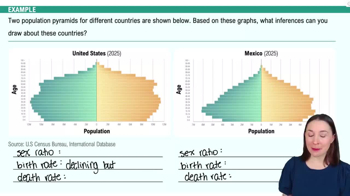
The sex ratio is the number of males per 100 females in a population.
An age-sex pyramid is a graphical representation showing the distribution of various age groups by sex in a population.
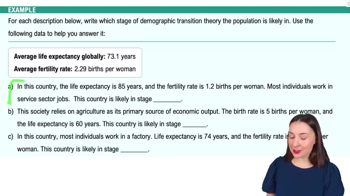
Demographic transition theory explains population change over time through stages of birth and death rate shifts linked to industrialization.
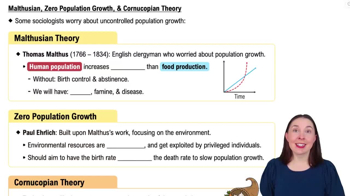
Zero population growth occurs when the number of births plus immigrants equals the number of deaths plus emigrants, stabilizing population size.
Urbanization is the increasing concentration of populations into cities and metropolitan areas.
A metropolis is a large city that serves as a significant economic, political, and cultural center.
Suburbs are residential areas located on the outskirts of a city or metropolis.
A megalopolis is a large, sprawling urban region formed by the merging of multiple metropolitan areas.
Gemeinschaft describes social relations based on close personal bonds, community, and tradition.
Gesellschaft refers to social relations characterized by impersonal, formal, and contractual interactions.
Urban ecology studies the relationship between people and their urban environment, focusing on social and spatial patterns.
Ecology is the study of interactions between organisms and their natural environment.
The natural environment includes all living and non-living things occurring naturally on Earth.
An ecosystem is a community of living organisms interacting with their physical environment.
Environmental deficit refers to the long-term harm to the environment caused by human activities.
Rain forests are dense, tropical forests with high rainfall, rich biodiversity, and critical ecological functions.
Global warming is the increase in Earth's average surface temperature due to greenhouse gas emissions.
Environmental racism describes the disproportionate impact of environmental hazards on minority and low-income communities.
An ecologically sustainable culture promotes living in ways that preserve natural resources for future generations.