 Indietro
Introductory Statistics: Chapter 1 Key Concepts
 04:24
04:24

Termini in questo insieme (24)
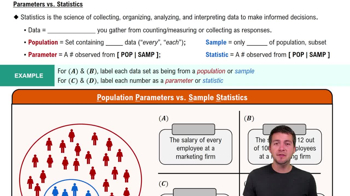
Descriptive statistics identify patterns in data, summarize data, and present data in a convenient form.
Inferential statistics use sample data to make estimates, predictions, decisions, or generalizations about a population.
A population is the collection of all outcomes, responses, measurements, or counts that are of interest.
A sample is a subset or part of the population used to collect data.
A parameter is a numerical description of a population characteristic.
A statistic is a numerical description of a sample characteristic.
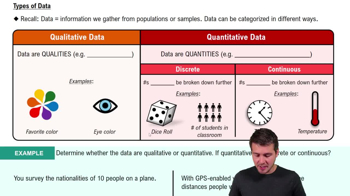
Quantitative data are numbers that represent measures or counts. Qualitative data are non-numerical or categorical data that cannot be measured on a natural numerical scale.
Nominal level is qualitative only; data cannot be ordered or ranked.
Ordinal level can be qualitative or quantitative; data can be ordered or ranked but differences between entries are not meaningful.
Interval level is quantitative; data can be ordered and differences are meaningful, but zero is not an inherent zero.
Ratio level is quantitative; data can be ordered, differences are meaningful, and zero represents an inherent zero (meaning none).
An observational study observes and measures characteristics of interest without changing existing conditions.
An experiment deliberately applies a treatment to part of the population and observes the responses.
Treatment is applied to part of the population (treatment group). The control group receives no treatment or a placebo. Experimental units are the subjects in both groups.
A simple random sample gives every member of the population an equal chance of being selected.
A stratified sample divides the population into strata by a characteristic, then randomly samples from each stratum proportionally.
A cluster sample divides the population into clusters, then selects all members from some clusters.
A systematic sample selects members at regular intervals from a randomly chosen starting point.
Population: All UCF students. Sample: The 30 UCF students surveyed.
The response is qualitative because it classifies students into categories (yes or no).
It was an experiment because researchers assigned smokers to CT or X-ray screening groups.
The experimental units were the 50,000 smokers participating in the trial.
The age is quantitative data because it is a measurable number.
The trial aims to infer which screening method (CT or X-ray) is more effective at early tumor detection.