Skip to main content
Introductory Statistics
Il mio corso
Impara
Preparazione agli esami
AI Tutor
Guide di studio
Soluzioni per libri di testo
Flashcard
Esplora
Prova l'app
Il mio corso
Impara
Preparazione agli esami
AI Tutor
Guide di studio
Soluzioni per libri di testo
Flashcard
Esplora
Prova l'app
Indietro
Introductory Statistics: Probability and Binomial Distributions
Puoi toccare per girare la carta.
Law of Large Numbers
Puoi toccare per girare la carta.
👆
Law of Large Numbers
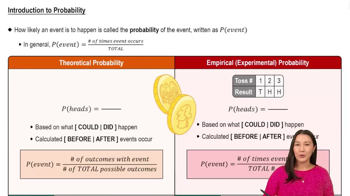
As the number of trials increases, the experimental probability values approach the classical probability.
Avanzamenti del tracciato
I pulsanti di controllo sono stati cambiati in modalità "navigazione".
1/20
Video consigliati
VideoThumbView.guidedCourse
5:37
Introduction to Probability
12441
views
476
rank
1
comments
Termini in questo insieme (20)
Nascondere definizioni
Law of Large Numbers
As the number of trials increases, the experimental probability values approach the classical probability.
Characteristics of Probability Distributions
Probabilities are between 0 and 1 inclusive, and the sum of all probabilities equals 1.
Binomial Distribution Outcomes
Binomial distributions have exactly two outcomes: success or failure.
Complement Rule in Probability
The probability of the complement of an event is \(1 - P(\text{event})\).
Addition Rule for Probability of A or B
P(A or B) = P(A) + P(B) - P(A and B) to avoid double counting the overlap.
Multiplication Rule for Independent Events
P(A and B) = P(A) × P(B) if events A and B are independent.
Conditional Probability Formula
P(B | A) = P(A and B) / P(A), where the denominator is the probability of event A.
Mean of a Binomial Distribution
The mean is calculated as \(\mu = n p\), where n is trials and p is success probability.
Variance of a Binomial Distribution
The variance is \(\sigma^2 = n p q\), where q = 1 - p.
Standard Deviation of a Binomial Distribution
The standard deviation is \(\sigma = \sqrt{n p q}\).
Using Binomial Distribution Tables
Write the inequality for the desired probability and use the table to find the corresponding values.
Probability Values Range
All probability values satisfy \(0 \leq P \leq 1\).
Sum of Probabilities in a Distribution
The sum of all probabilities in a probability distribution equals 1.
Interpreting P(A and B)
P(A and B) represents the probability that both events A and B occur simultaneously.
Interpreting P(A or B)
P(A or B) represents the probability that at least one of the events A or B occurs.
Success and Failure in Binomial Trials
Each trial results in either a success or a failure, with fixed probabilities.
Calculating Complement Probability
To find the probability that an event does not occur, subtract its probability from 1.
Reading Probability Tables
Use the given tables to find probabilities for events or cumulative probabilities based on inequalities.
Probability of Independent Events
If events are independent, the probability of both occurring is the product of their individual probabilities.
Notation for Probability of Conditional Events
P(B | A) denotes the probability of event B occurring given that event A has occurred.
 IndietroIndietro
 5:37
