In Exercises 1–6, the measure of an angle is given. Classify the angle as acute, right, obtuse, or straight. 87.177°
Ch. 1 - Angles and the Trigonometric Functions

Capitolo 1, Problema 4
In Exercises 1–8, a point on the terminal side of angle θ is given. Find the exact value of each of the six trigonometric functions of θ. (3, 7)
Guida verificata passo dopo passo1
Identify the coordinates of the point on the terminal side of angle \( \theta \). Here, the point is \( (3, 7) \), so \( x = 3 \) and \( y = 7 \).
Calculate the radius \( r \), which is the distance from the origin to the point, using the formula \( r = \sqrt{x^2 + y^2} \). Substitute the values to get \( r = \sqrt{3^2 + 7^2} \).
Recall the definitions of the six trigonometric functions in terms of \( x \), \( y \), and \( r \):
\[ \sin \theta = \frac{y}{r}, \quad \cos \theta = \frac{x}{r}, \quad \tan \theta = \frac{y}{x}, \quad \csc \theta = \frac{r}{y}, \quad \sec \theta = \frac{r}{x}, \quad \cot \theta = \frac{x}{y} \]
Substitute the values of \( x \), \( y \), and \( r \) into each of the six functions to express them exactly in terms of radicals and integers.
Simplify each expression if possible, but do not approximate the values numerically to maintain exactness.

Risposta video verificata per un problema simile:
Questa soluzione video è stata consigliata dai nostri tutor come utile per risolvere questo problema.
Durata del video:
6mConcetti chiave
Ecco i concetti essenziali che devi comprendere per rispondere correttamente alla domanda.
Coordinates and the Terminal Side of an Angle
The terminal side of an angle θ in standard position passes through a point (x, y). These coordinates represent the position on the Cartesian plane, which helps determine the values of trigonometric functions based on the angle's location.
Video consigliato:
Percorso guidato
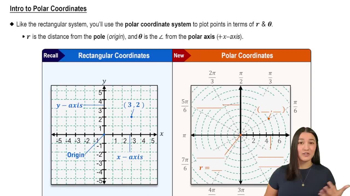
Intro to Polar Coordinates
Definition of the Six Trigonometric Functions
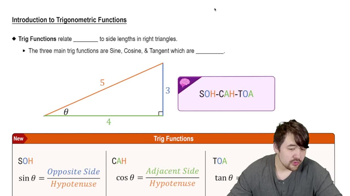
The six trigonometric functions—sine, cosine, tangent, cosecant, secant, and cotangent—are ratios involving the coordinates (x, y) and the radius r = √(x² + y²). For example, sin(θ) = y/r and cos(θ) = x/r, linking geometry to trigonometry.
Video consigliato:
Percorso guidato
Introduction to Trigonometric Functions
Calculating the Radius (r) from Coordinates
The radius r is the distance from the origin to the point (x, y), calculated using the Pythagorean theorem: r = √(x² + y²). This value is essential for finding the exact values of trigonometric functions since it normalizes the coordinates.
Video consigliato:
Percorso guidato
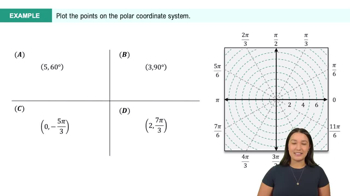
Intro to Polar Coordinates Example 1
Pratica correlata
Domanda del libro di testo
616
views
Domanda del libro di testo
A point P(x, y) is shown on the unit circle corresponding to a real number t. Find the values of the trigonometric functions at t.
<IMAGE>
385
views
Domanda del libro di testo
In Exercises 2–4, convert each angle in degrees to radians. Express your answer as a multiple of 𝜋. 315°
527
views
Domanda del libro di testo
In Exercises 1–8, use the Pythagorean Theorem to find the length of the missing side of each right triangle. Then find the value of each of the six trigonometric functions of θ.
1359
views
Domanda del libro di testo
In Exercises 1–4, a point P(x, y) is shown on the unit circle corresponding to a real number t. Find the values of the trigonometric functions at t.
1565
views
Domanda del libro di testo
In Exercises 2–4, convert each angle in degrees to radians. Express your answer as a multiple of 𝜋. 15°
547
views