In Exercises 21–28, an object moves in simple harmonic motion described by the given equation, where t is measured in seconds and d in inches. In each exercise, find the following: a. the maximum displacement b. the frequency c. the time required for one cycle. d = −4 sin 3π/2 t
Ch. 2 - Graphs of the Trigonometric Functions; Inverse Trigonometric Functions

Tutti i libri di testo
Blitzer 3rd Edition
Ch. 2 - Graphs of the Trigonometric Functions; Inverse Trigonometric Functions
Problema 29
Blitzer 3rd Edition
Ch. 2 - Graphs of the Trigonometric Functions; Inverse Trigonometric Functions
Problema 29Capitolo 2, Problema 29
In Exercises 29–36, find the length x to the nearest whole unit.
Guida verificata passo dopo passo1
Identify the type of triangle involved in the problem (right triangle, oblique triangle, etc.) and the given information such as angles and side lengths.
Choose the appropriate trigonometric ratio or law based on the given information. For right triangles, use sine, cosine, or tangent: \(\sin \theta = \frac{\text{opposite}}{\text{hypotenuse}}\), \(\cos \theta = \frac{\text{adjacent}}{\text{hypotenuse}}\), or \(\tan \theta = \frac{\text{opposite}}{\text{adjacent}}\). For non-right triangles, consider the Law of Sines or Law of Cosines.
Set up an equation using the chosen trigonometric ratio or law, substituting the known values and the variable \(x\) for the unknown side length.
Solve the equation algebraically to isolate \(x\). This may involve multiplying both sides, dividing, or using inverse trigonometric functions if angles need to be found first.
Once you have the expression for \(x\), round the result to the nearest whole unit as requested.

Risposta video verificata per un problema simile:
Questa soluzione video è stata consigliata dai nostri tutor come utile per risolvere questo problema.
Durata del video:
4mConcetti chiave
Ecco i concetti essenziali che devi comprendere per rispondere correttamente alla domanda.
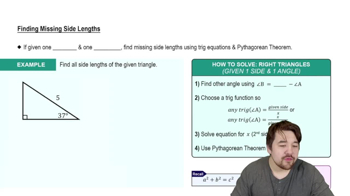
Right Triangle Side Lengths
Understanding how to find unknown side lengths in right triangles is fundamental. This often involves using relationships between the sides, such as the Pythagorean theorem or trigonometric ratios, to solve for the missing length.
Video consigliato:
Percorso guidato
Finding Missing Side Lengths
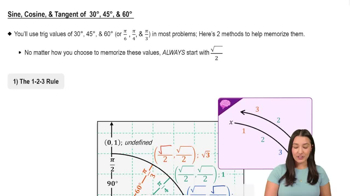
Trigonometric Ratios (Sine, Cosine, Tangent)
Sine, cosine, and tangent relate the angles of a right triangle to the ratios of its sides. Knowing which ratio to use depends on the given angle and sides, enabling calculation of unknown lengths when an angle and one side are known.
Video consigliato:
Percorso guidato
Sine, Cosine, & Tangent of 30°, 45°, & 60°
Rounding and Approximation
After calculating the length x, rounding to the nearest whole unit is necessary for practical answers. This involves understanding decimal values and applying standard rounding rules to present the solution clearly and accurately.
Video consigliato:
Percorso guidato
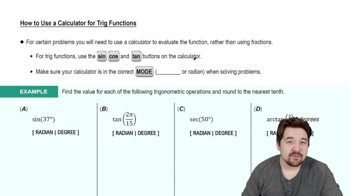
How to Use a Calculator for Trig Functions
Pratica correlata
Domanda del libro di testo
1160
views
Domanda del libro di testo
In Exercises 27–38, use a calculator to find the value of each expression rounded to two decimal places. sin⁻¹ 0.3
743
views
Domanda del libro di testo
In Exercises 29–44, graph two periods of the given cosecant or secant function. y = 3 csc x
1018
views
Domanda del libro di testo
In Exercises 17–30, determine the amplitude, period, and phase shift of each function. Then graph one period of the function. y = −2 sin(2πx + 4π)
561
views
Domanda del libro di testo
Use each graph to obtain the graph of the corresponding reciprocal function, cosecant or secant. Give the equation of the function for the graph that you obtain.
<IMAGE>
485
views
Domanda del libro di testo
In Exercises 27–38, use a calculator to find the value of each expression rounded to two decimal places. sin⁻¹ (-0.32)
800
views