In Exercises 21–38, let
u = 2i - 5j, v = -3i + 7j, and w = -i - 6j.
Find each specified vector or scalar.
u + v
Guida verificata passo dopo passo
1
Identify the components of vector \( u \) as \( 2i - 5j \).
Identify the components of vector \( v \) as \( -3i + 7j \).
Add the corresponding components of vectors \( u \) and \( v \): \( (2i + (-3i)) \) and \( (-5j + 7j) \).
Simplify the addition of the \( i \) components: \( 2i - 3i \).
Simplify the addition of the \( j \) components: \( -5j + 7j \).
Risposta video verificata per un problema simile:
Questa soluzione video è stata consigliata dai nostri tutor come utile per risolvere questo problema.
Durata del video:
1m
Guarda un video:
0 Commenti
Concetti chiave
Ecco i concetti essenziali che devi comprendere per rispondere correttamente alla domanda.
Vector Addition
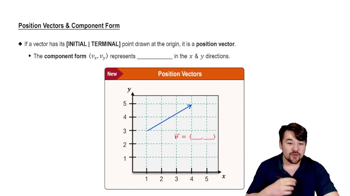
Vector addition involves combining two or more vectors to form a resultant vector. This is done by adding their corresponding components. For example, if vector u has components (2, -5) and vector v has components (-3, 7), their sum is calculated by adding the i-components and the j-components separately, resulting in a new vector.
Vectors can be expressed in component form, typically as a combination of unit vectors i and j in a two-dimensional space. For instance, a vector u = 2i - 5j indicates it has a horizontal component of 2 and a vertical component of -5. Understanding this form is essential for performing operations like addition or subtraction.
The resultant vector is the vector that results from the addition of two or more vectors. It represents the cumulative effect of the individual vectors. In the context of the question, finding u + v will yield a resultant vector that combines the effects of both vectors, providing a new direction and magnitude.


 Guida verificata passo dopo passo
 05:29
05:29