Ch. 7 - Applications of Trigonometry and Vectors
Lial - Trigonometry 12th Edition
Lial12th EditionTrigonometryISBN: 9780136552161, 9780135440780, 9780136881117, 9780135440827, 9780135924891Non è quello che usi tu?Cambia libro di testo
Capitolo 8, Problema 45

A ship leaves port on a bearing of 34.0° and travels 10.4 mi. The ship then turns due east and travels 4.6 mi. How far is the ship from port, and what is its bearing from port?

Guida verificata passo dopo passo
1
Draw a diagram to visualize the ship's path: start at the port (origin), draw a line representing the ship's first leg of 10.4 miles at a bearing of 34.0° from north, then from that point draw a second leg 4.6 miles due east.
Resolve the first leg of the journey into its north-south and east-west components using trigonometry: calculate the eastward component as \(10.4 \times \sin(34.0^\circ)\) and the northward component as \(10.4 \times \cos(34.0^\circ)\).
Add the eastward component of the second leg (4.6 miles due east) to the eastward component from the first leg to get the total eastward displacement from the port. The northward displacement remains the same as from the first leg since the second leg is due east.
Use the Pythagorean theorem to find the straight-line distance from the port to the ship's final position: calculate \(\sqrt{(\text{total eastward displacement})^2 + (\text{northward displacement})^2}\).
Find the bearing from the port to the ship's final position by calculating the angle east of north using the inverse tangent function: \(\theta = \tan^{-1}\left(\frac{\text{total eastward displacement}}{\text{northward displacement}}\right)\). This angle is the bearing measured clockwise from north.

Risposta video verificata per un problema simile:

Questa soluzione video è stata consigliata dai nostri tutor come utile per risolvere questo problema.
Durata del video:
10m

Concetti chiave

Ecco i concetti essenziali che devi comprendere per rispondere correttamente alla domanda.

Bearing and Direction in Navigation

Bearing is the direction or path along which something moves, measured in degrees clockwise from the north. Understanding how to interpret bearings, such as 34°, is essential for determining the ship's initial direction relative to the port.
Video consigliato:
Percorso guidato
05:13
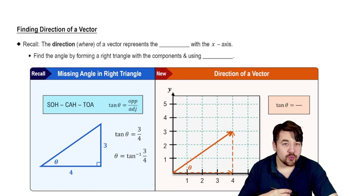
Finding Direction of a Vector

Vector Addition and Displacement

The ship's journey involves two legs with different directions, so its overall displacement is found by vector addition. Breaking each leg into components (using trigonometric functions) allows calculation of the resultant position relative to the starting point.
Video consigliato:
Percorso guidato
05:29
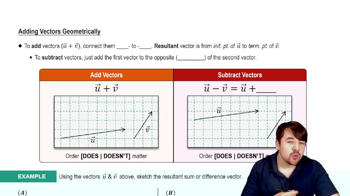
Adding Vectors Geometrically

Trigonometric Functions and Distance Calculation

Using sine and cosine functions helps resolve distances into perpendicular components. The Pythagorean theorem then calculates the straight-line distance from the port, and inverse trigonometric functions determine the bearing from the port.
Video consigliato:
Percorso guidato
4:45
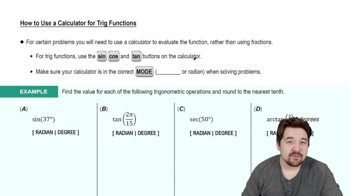
How to Use a Calculator for Trig Functions