Skip to main content
Analytical Chemistry
Il mio corso
Impara
Preparazione agli esami
AI Tutor
Guide di studio
Flashcard
Esplora
Prova l'app
Il mio corso
Impara
Preparazione agli esami
AI Tutor
Guide di studio
Flashcard
Esplora
Prova l'app
Indietro
Chemical Concentrations quiz
Puoi toccare per girare la carta.
What is the effect of the number of ions dissolved in a solution on its physical properties?
Puoi toccare per girare la carta.
👆
What is the effect of the number of ions dissolved in a solution on its physical properties?
The number of ions dissolved in a solution can directly impact the physical properties of that solution.
Avanzamenti del tracciato
I pulsanti di controllo sono stati cambiati in modalità "navigazione".
1/15
Flashcard correlate
Pratica correlata
Video consigliati
Chemical Concentrations quiz #1
Chemical Concentrations
10 Termini
Chemical Concentrations definitions
Chemical Concentrations
14 Termini
Chemical Concentrations
1. Chemical Measurements
5 Problemi
Argomento
Volumetric Analysis
1. Chemical Measurements
5 Problemi
Argomento
1. Chemical Measurements - Part 1 of 2
4 Argomenti
12 Problemi
Capitolo
1. Chemical Measurements - Part 2 of 2
1 Argomento
3 Problemi
Capitolo
VideoThumbView.guidedCourse
04:50
Molarity & Molality 1
547
views
8
rank
VideoThumbView.guidedCourse
01:54
Molarity vs. Molality
894
views
7
rank
VideoThumbView.guidedCourse
05:46
Molarity & Molality
766
views
11
rank
1
comments
Termini in questo insieme (15)
Nascondere definizioni
What is the effect of the number of ions dissolved in a solution on its physical properties?
The number of ions dissolved in a solution can directly impact the physical properties of that solution.
What is the definition of a solution in chemistry?
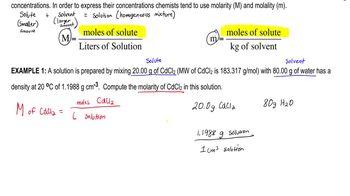
A solution is a homogeneous mixture in which the solvent has dissolved at least an appreciable amount of solute.
What is the solute in a solution?
The solute is the smaller portion of a solution, present in a lesser amount compared to the solvent.
What is the solvent in a solution?
The solvent is the larger portion of a solution, present in a greater amount than the solute.
How is molarity (M) defined?
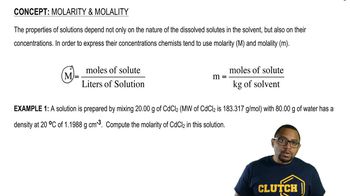
Molarity is defined as the moles of solute divided by the liters of solution.
How is molality defined?
Molality is defined as the moles of solute divided by the kilograms of solvent.
What do molarity and molality have in common?
Both molarity and molality use moles of solute in their calculations.
Why is it important to understand units like molarity and molality in analytical chemistry?
Understanding these units is important because they are used to describe concentrations of solutions, which is essential in analytical chemistry.
What is the main difference between molarity and molality?
Molarity uses liters of solution as the denominator, while molality uses kilograms of solvent.
Why are concepts from general chemistry reintroduced in analytical chemistry?
They are reintroduced because foundational knowledge from general chemistry is necessary for solving analytical chemistry problems.
What is meant by a homogeneous mixture?
A homogeneous mixture is one in which the composition is uniform throughout, such as a solution.
What is the significance of the solvent dissolving an appreciable amount of solute?
It means that enough solute has dissolved to affect the properties of the solution and make it homogeneous.
What is the symbol for molarity and what does it represent?
The symbol for molarity is a capital M, and it represents moles of solute per liter of solution.
In the context of solutions, what is typically the larger component?
The solvent is typically the larger component in a solution.
What will the next lesson cover according to the transcript?
The next lesson will cover solving the molarity of a given solution.
 IndietroIndietro
 04:50
04:50