Skip to main content
Analytical Chemistry
Il mio corso
Impara
Preparazione agli esami
AI Tutor
Guide di studio
Flashcard
Esplora
Prova l'app
Il mio corso
Impara
Preparazione agli esami
AI Tutor
Guide di studio
Flashcard
Esplora
Prova l'app
Indietro
Coulometry definitions
Puoi toccare per girare la carta.
Electrochemical Cell
Puoi toccare per girare la carta.
👆
Electrochemical Cell
A system where chemical reactions involve electron transfer, classified by reaction spontaneity and energy flow.
Avanzamenti del tracciato
I pulsanti di controllo sono stati cambiati in modalità "navigazione".
1/15
Flashcard correlate
Pratica correlata
Video consigliati
Coulometry quiz
Coulometry
15 Termini
Coulometry
16. Electroanalytical Techniques
5 Problemi
Argomento
Voltammetry
16. Electroanalytical Techniques
5 Problemi
Argomento
16. Electroanalytical Techniques
4 Argomenti
12 Problemi
Capitolo
VideoThumbView.guidedCourse
06:11
Coulometry
251
views
Termini in questo insieme (15)
Nascondere definizioni
Electrochemical Cell
A system where chemical reactions involve electron transfer, classified by reaction spontaneity and energy flow.
Galvanic Cell
A device that converts spontaneous chemical energy into electrical energy, producing electricity as it operates.
Electrolytic Cell
A setup requiring external energy to drive non-spontaneous reactions, consuming electricity to function.
Spontaneity
A property indicating whether a reaction proceeds naturally without external energy input, linked to cell type.
Gibbs Free Energy
A thermodynamic quantity predicting reaction direction; negative values indicate spontaneous processes.
Equilibrium Constant
A ratio expressing the concentrations of products to reactants at equilibrium, revealing reaction favorability.
Cell Potential
The voltage difference between electrodes, determining the ability of a cell to drive electron flow.
Entropy
A measure of disorder or randomness in a system, influencing reaction spontaneity and cell classification.
Reaction Quotient
A value comparing current reactant and product concentrations to those at equilibrium, indicating reaction direction.
Anode
The electrode where oxidation occurs, with its charge depending on cell type—negative in galvanic, positive in electrolytic.
Cathode
The electrode where reduction takes place, with its charge reversed between galvanic and electrolytic cells.
Oxidation
A process involving electron loss at one electrode, always occurring at the same location in both cell types.
Reduction
A process involving electron gain at one electrode, consistently occurring at the same site in all electrochemical cells.
Equilibrium
A state where all driving forces balance, resulting in no net reaction and representing a 'dead battery' in cells.
Battery
An external energy source required to drive non-spontaneous reactions in electrolytic cells, forcing electron movement.
 IndietroIndietro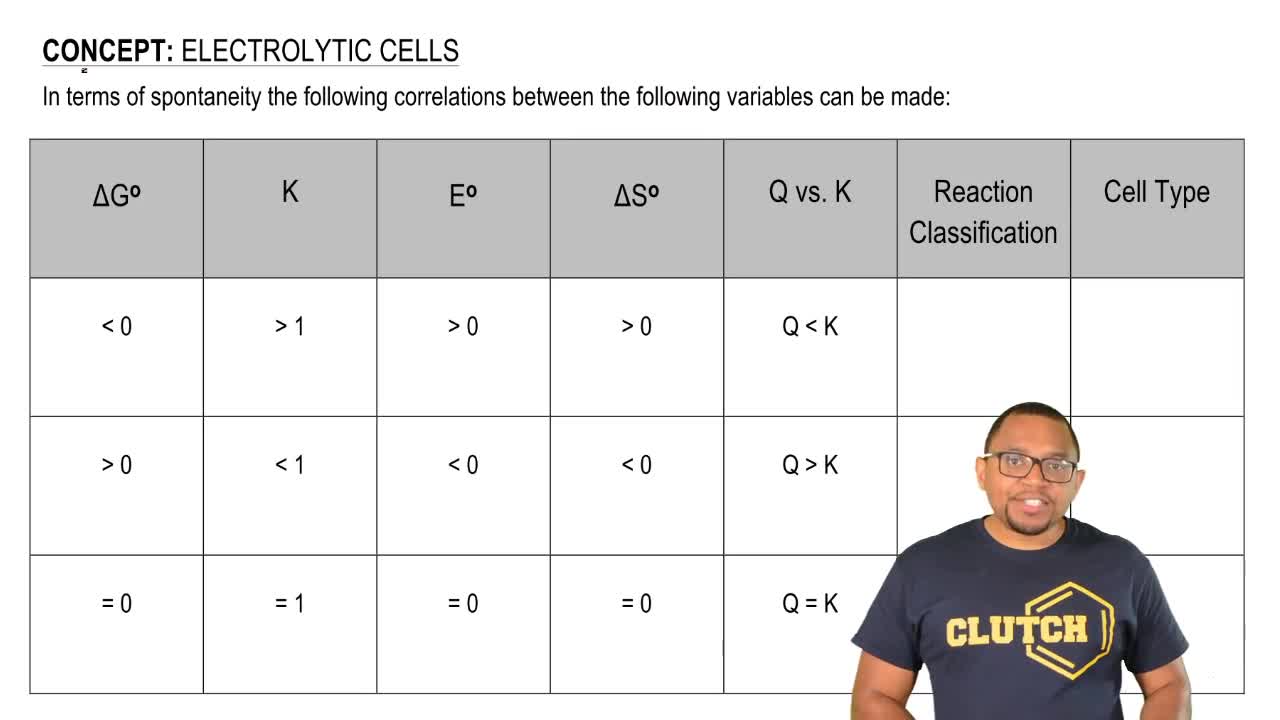
 06:11
06:11