Skip to main content
Analytical Chemistry
Il mio corso
Impara
Preparazione agli esami
AI Tutor
Guide di studio
Flashcard
Esplora
Prova l'app
Il mio corso
Impara
Preparazione agli esami
AI Tutor
Guide di studio
Flashcard
Esplora
Prova l'app
Indietro
Glass Electrodes and pH Measurements quiz
Puoi toccare per girare la carta.
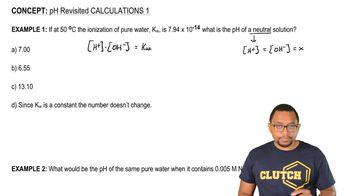
How do you calculate the pH of pure water at 50°C given Kw = 7.94 x 10^-14?
Puoi toccare per girare la carta.
👆
How do you calculate the pH of pure water at 50°C given Kw = 7.94 x 10^-14?
Take the square root of Kw to find [H+], then calculate pH as -log([H+]); the answer is 6.55.
Avanzamenti del tracciato
I pulsanti di controllo sono stati cambiati in modalità "navigazione".
1/15
Flashcard correlate
Pratica correlata
Video consigliati
Glass Electrodes and pH Measurements definitions
Glass Electrodes and pH Measurements
15 Termini
Glass Electrodes and pH Measurements
14. Electrodes and Potentiometry
5 Problemi
Argomento
Junction Potential
14. Electrodes and Potentiometry
5 Problemi
Argomento
14. Electrodes and Potentiometry
4 Argomenti
11 Problemi
Capitolo
VideoThumbView.guidedCourse
06:13
Glass Electrodes
442
views
2
rank
2
comments
VideoThumbView.guidedCourse
02:24
Glass Electrodes
415
views
VideoThumbView.guidedCourse
06:04
Glass Electrodes
463
views
3
comments
Termini in questo insieme (15)
Nascondere definizioni
How do you calculate the pH of pure water at 50°C given Kw = 7.94 x 10^-14?
Take the square root of Kw to find [H+], then calculate pH as -log([H+]); the answer is 6.55.
What is the relationship between [H+] and [OH-] in pure water?
In pure water, [H+] equals [OH-] because water ionizes equally into both ions.
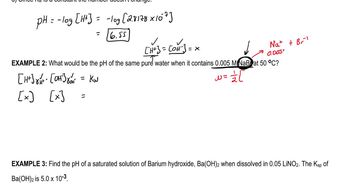
How does temperature affect the value of Kw?
Kw is temperature dependent; as temperature changes, Kw changes from its value at 25°C.
What is the effect of adding Na+ and Br- ions to pure water on pH calculation?
Adding Na+ and Br- increases ionic strength, requiring the use of activity coefficients in pH calculations.
What is the ionic strength formula for a solution containing Na+ and Br-?
Ionic strength = 0.5 × (concentration of Na+ × charge^2 + concentration of Br- × charge^2).
How do you use activity coefficients in pH calculations?
Multiply the ion concentration by its activity coefficient before taking the negative log to find pH.
What is the impact of ionic strength on the activity coefficient?
Higher ionic strength lowers the activity coefficient, affecting the effective concentration of ions.
How does the presence of non-common ions affect solubility product (Ksp) calculations?
Non-common ions increase ionic strength, requiring the use of activity coefficients in Ksp calculations.
What is the Ksp expression for barium hydroxide dissolving in solution?
Ksp = [Ba^2+][OH^-]^2, but with activity coefficients, it becomes Ksp = [Ba^2+](γ_Ba^2+)[OH^-]^2(γ_OH^-)^2.
How do you find the pH of a saturated Ba(OH)2 solution in 0.05 M LiNO3?
Calculate [OH^-] using Ksp and activity coefficients, find pOH as -log(activity of OH^-), then pH = 14 - pOH.
Why do you multiply the concentration of OH^- by 2 when calculating from Ba(OH)2?
Because each Ba(OH)2 produces two OH^- ions for every one Ba^2+ ion dissolved.
What is the effect of increasing the concentration or charge of ions on pH?
Increasing concentration or charge increases ionic strength, which can have a greater impact on pH.
How do you determine the activity of an ion in solution?
Multiply the ion's concentration by its activity coefficient to get its activity.
What is the final pH of a saturated Ba(OH)2 solution in 0.05 M LiNO3, given the calculations?
The final pH is approximately 13.41 after accounting for ionic strength and activity coefficients.
Why must activity coefficients be considered in solutions with non-common ions?
Because non-common ions increase ionic strength, altering the effective concentrations of ions involved in equilibrium.
 IndietroIndietro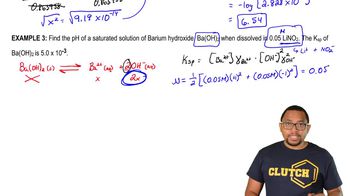
 06:13
06:13