Skip to main content
Analytical Chemistry
Il mio corso
Impara
Preparazione agli esami
AI Tutor
Guide di studio
Flashcard
Esplora
Prova l'app
Il mio corso
Impara
Preparazione agli esami
AI Tutor
Guide di studio
Flashcard
Esplora
Prova l'app
Indietro
Logarithm and Anti-Logarithm Operations definitions
Puoi toccare per girare la carta.
Logarithm
Puoi toccare per girare la carta.
👆
Logarithm
Mathematical operation expressing a number as an exponent of a base, commonly used to simplify multiplication and division.
Avanzamenti del tracciato
I pulsanti di controllo sono stati cambiati in modalità "navigazione".
1/12
Flashcard correlate
Pratica correlata
Video consigliati
Logarithm and Anti-Logarithm Operations quiz
Logarithm and Anti-Logarithm Operations
15 Termini
Logarithm and Anti-Logarithm Operations
3. Experimental Error
5 Problemi
Argomento
Precision and Accuracy
3. Experimental Error
5 Problemi
Argomento
3. Experimental Error - Part 1 of 2
4 Argomenti
12 Problemi
Capitolo
3. Experimental Error - Part 2 of 2
3 Argomenti
9 Problemi
Capitolo
VideoThumbView.guidedCourse
02:23
Log and Anti-Log
330
views
1
rank
VideoThumbView.guidedCourse
02:00
Log and Anti-Log
322
views
1
rank
2
comments
VideoThumbView.guidedCourse
01:42
Log and Anti-Log
345
views
1
rank
Termini in questo insieme (12)
Nascondere definizioni
Logarithm
Mathematical operation expressing a number as an exponent of a base, commonly used to simplify multiplication and division.
Anti-Logarithm
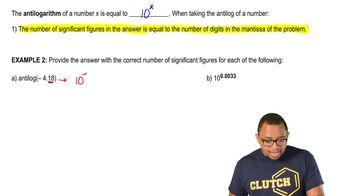
Inverse process of logarithms, converting a logarithmic value back to its original number, often calculated as 10 raised to a given power.
Significant Figures
Digits in a value that contribute to its precision, including all nonzero digits and any zeros between them or after a decimal point.
Mantissa
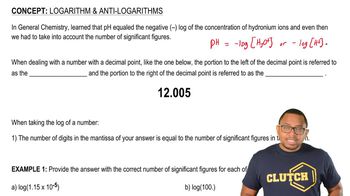
Decimal portion of a logarithmic value, following the decimal point, whose digits reflect the precision of the original number.
Characteristic
Integer part of a logarithmic value, indicating the order of magnitude or the power of ten in scientific notation.
Scientific Notation
Method of expressing numbers as a product of a coefficient and a power of ten, facilitating calculations with very large or small values.
pH
Scale representing the acidity or basicity of a solution, calculated as the negative logarithm of hydrogen ion concentration.
Equilibrium Constant
Value expressing the ratio of product to reactant concentrations at equilibrium, often calculated using logarithmic relationships.
Gibbs Free Energy
Thermodynamic property indicating the spontaneity of a process, frequently related to equilibrium constants via logarithmic equations.
Decimal Point
Symbol separating the integer and fractional parts of a number, crucial for identifying significant figures in calculations.
Order of Magnitude
Scale or class of size defined by powers of ten, often determined by the characteristic in logarithmic expressions.
Precision
Degree of exactness in a measurement, directly influenced by the number of significant figures retained in calculations.
 IndietroIndietro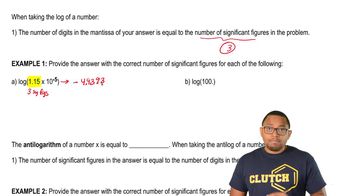
 02:23
02:23