Skip to main content
Analytical Chemistry
Il mio corso
Impara
Preparazione agli esami
AI Tutor
Guide di studio
Flashcard
Esplora
Prova l'app
Il mio corso
Impara
Preparazione agli esami
AI Tutor
Guide di studio
Flashcard
Esplora
Prova l'app
Indietro
Thermal Dependency quiz
Puoi toccare per girare la carta.
What is the main purpose of calibration in analytical chemistry?
Puoi toccare per girare la carta.
👆
What is the main purpose of calibration in analytical chemistry?
Calibration ensures precision and accuracy by minimizing external factors that can affect measurements.
Avanzamenti del tracciato
I pulsanti di controllo sono stati cambiati in modalità "navigazione".
1/15
Flashcard correlate
Pratica correlata
Video consigliati
Thermal Dependency definitions
Thermal Dependency
15 Termini
Thermal Dependency
2. Tools of the Trade
5 Problemi
Argomento
Volumetric Instruments
2. Tools of the Trade
5 Problemi
Argomento
2. Tools of the Trade - Part 1 of 2
4 Argomenti
11 Problemi
Capitolo
2. Tools of the Trade - Part 2 of 2
1 Argomento
3 Problemi
Capitolo
VideoThumbView.guidedCourse
02:25
Thermal Expansion
235
views
1
comments
VideoThumbView.guidedCourse
03:49
Thermal Expansion
327
views
VideoThumbView.guidedCourse
03:07
Thermal Dependency Calculations
241
views
Termini in questo insieme (15)
Nascondere definizioni
What is the main purpose of calibration in analytical chemistry?
Calibration ensures precision and accuracy by minimizing external factors that can affect measurements.
Why must thermal expansion be considered when measuring solutions?
Thermal expansion affects the volume and density of solutions, which can impact the accuracy of measurements.
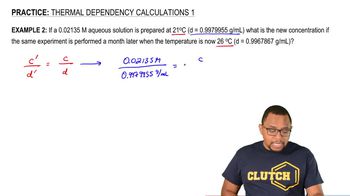
What do c' and d' represent in the context of thermal corrections?
c' is the corrected concentration and d' is the corrected density of a solution after accounting for temperature changes.
How does the density of water change as temperature increases from 10°C to 30°C?
The density of water decreases as temperature increases from 10°C to 30°C.
Why does the density of water decrease with increasing temperature?
As temperature increases, the volume of water increases while mass remains constant, causing density to decrease.
At what temperature is standard glassware typically calibrated for accurate volume readings?
Standard glassware is typically calibrated at 20 degrees Celsius.
What is the delivered volume of 1 gram of water at 10°C?
At 10°C, 1 gram of water delivers 1.0014 milliliters.
What is the delivered volume of 1 gram of water at 20°C?
At 20°C, 1 gram of water delivers 1.0015 milliliters.
How does thermal expansion affect the accuracy of chemical measurements?
Thermal expansion can change the volume and density of substances, leading to inaccurate measurements if not corrected.
What is the relationship between temperature and volume in liquids?
As temperature increases, the volume of a liquid generally increases.
Why is it important to correct glassware to a standard temperature?
Correcting glassware to a standard temperature ensures more accurate and consistent volume measurements.
What happens to the mass of water as temperature increases?
The mass of water remains constant as temperature increases.
How does an increase in volume affect density if mass stays the same?
If volume increases while mass stays the same, density decreases.
What is the formula for density?
Density is calculated as mass divided by volume.
Why is understanding thermal dependency important in analytical chemistry?
Understanding thermal dependency is crucial for making accurate chemical measurements and properly handling thermal expansion effects.
 IndietroIndietro
 02:25
02:25