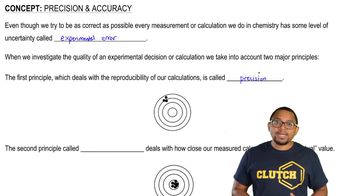
Precision is the degree of mutual agreement among data obtained in the same way, often expressed as standard deviation or coefficient of variation.
Define accuracy in the context of analytical measurements.
Accuracy is the closeness of a measured value to the accepted true value, often expressed as absolute or relative error.
What is the difference between sensitivity and limit of detection (LOD)?
Sensitivity is the ability to discriminate small differences in analyte concentration (slope of calibration curve), while LOD is the minimum concentration detectable with confidence, typically 3 times the noise standard deviation.
What does the dynamic range of an analytical method represent?
The dynamic range is the concentration range over which accurate measurements can be made, from the limit of quantitation (LOQ) to the limit of linearity (LOL).
Explain the term 'selectivity' in analytical methods.
Selectivity is the degree to which a method is free from interference by other substances in the sample matrix.
What is the formula for absolute standard deviation (s)?
s = \(\sqrt{\frac{\sum_{i=1}^N (x_i - \bar{x})^2}{N-1}}\), measuring spread of data points around the mean.
How is relative standard deviation (RSD) calculated?
RSD = \(\frac{s}{\bar{x}}\), expressing standard deviation as a percentage of the mean.
What is the coefficient of variation (CV) and its formula?
CV = \(\frac{s}{\bar{x}} \times 100\%\), a normalized measure of dispersion.
Describe the standard error of the mean (s_m).
s_m = \(\frac{s}{\sqrt{N}}\), estimating the precision of the sample mean.
What is the limit of quantitation (LOQ)?
LOQ is the lowest concentration at which the analyte can be quantitatively detected with acceptable precision, typically 10 times the blank standard deviation.
What is the limit of linearity (LOL) in calibration curves?
LOL is the highest concentration at which the calibration curve remains linear, often defined by a 5% deviation from linearity.
What is an external standard calibration method?
A method where standards are prepared separately from the sample, and a calibration curve is generated to determine unknown concentrations.
Explain the internal standard calibration method.
An internal standard, different from the analyte, is added in constant amount to all samples and standards to correct for random and systematic errors.
What is the purpose of the standard additions method?
Standard additions compensate for matrix effects by adding known amounts of analyte to the sample and measuring the combined signal.
How is the analyte concentration determined using standard additions?
By plotting combined signal vs. added standard volume and extrapolating to zero signal, the unknown concentration is calculated from the x-intercept.
What are systematic errors in analytical measurements?
Errors that consistently bias results in the same direction, caused by instrument faults, method issues, or personal judgment.
What are random errors and how are they handled?
Random errors cause scatter in data and are handled statistically using measures like standard deviation and confidence intervals.
What is the role of a monochromator or filter in an instrument setup?
It isolates specific wavelengths of light from the source to interact with the sample for selective measurement.
What is the function of the amplifier in an analytical instrument?
The amplifier increases the signal from the photodetector to a measurable level for readout.
How is variance defined mathematically?
Variance = \(s^2\), the square of the standard deviation, representing data spread.
 Indietro
 01:30
01:30