Choose the pair of terms that correctly completes this sentence: Catabolism is to anabolism as is to .
a. exergonic; spontaneous
b. exergonic; endergonic
c. free energy; entropy
d. work; energy
Guida verificata passo dopo passo
1
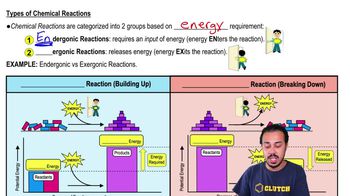
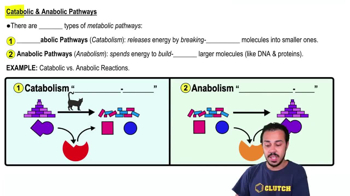
Identify the definitions of catabolism and anabolism: Catabolism involves breaking down molecules to release energy, while anabolism involves building up molecules, which requires energy.
Recognize the type of reactions: Catabolic reactions are typically exergonic, meaning they release energy, whereas anabolic reactions are endergonic, meaning they require energy input.
Match the terms: Since catabolism is to anabolism as exergonic is to endergonic, identify the pair that reflects this relationship.
Review the options: Look for the pair that correctly associates catabolism with exergonic and anabolism with endergonic.
Select the correct answer: Choose the option that pairs exergonic with endergonic, reflecting the relationship between catabolism and anabolism.
Risposta video verificata per un problema simile:
Questa soluzione video è stata consigliata dai nostri tutor come utile per risolvere questo problema.
Durata del video:
50s
Guarda un video:
0 Commenti
Concetti chiave
Ecco i concetti essenziali che devi comprendere per rispondere correttamente alla domanda.
Catabolism and Anabolism
Catabolism refers to the metabolic pathways that break down molecules into smaller units, releasing energy in the process. In contrast, anabolism involves the synthesis of complex molecules from simpler ones, requiring energy input. Understanding the relationship between these two processes is crucial for grasping metabolic functions in biological systems.
Exergonic reactions are those that release energy, often associated with catabolic processes, while endergonic reactions require an input of energy, typical of anabolic processes. This distinction is essential for understanding how energy transformations occur in biological systems and how they relate to metabolic pathways.
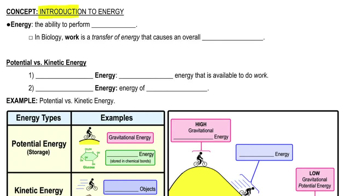
Free energy, often denoted as Gibbs free energy, is a thermodynamic quantity that indicates the amount of energy available to do work in a system at constant temperature and pressure. It plays a critical role in determining the spontaneity of reactions, where a decrease in free energy indicates a spontaneous process, aligning with catabolic reactions, while an increase indicates non-spontaneity, typical of anabolic reactions.