A biochemist isolates, purifies, and combines in a test tube a variety of molecules needed for DNA replication. When she adds some DNA to the mixture, replication occurs, but each DNA molecule consists of a normal strand paired with numerous segments of DNA a few hundred nucleotides long. What has she probably left out of the mixture?
a. DNA polymerase
b. DNA ligase
c. Okazaki fragments
d. primase
Guida verificata passo dopo passo
1
Identify the process described: DNA replication.
Understand the issue: DNA molecules have normal strands paired with segments of DNA a few hundred nucleotides long.
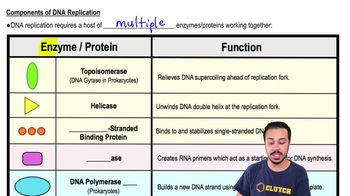
Recall the role of each component in DNA replication: DNA polymerase synthesizes new DNA strands, DNA ligase joins Okazaki fragments, Okazaki fragments are short DNA sequences, and primase synthesizes RNA primers.
Recognize that the presence of segments suggests that the short DNA sequences (Okazaki fragments) are not being joined together.
Conclude that the missing component is likely the enzyme responsible for joining these fragments, which is DNA ligase.
Risposta video verificata per un problema simile:
Questa soluzione video è stata consigliata dai nostri tutor come utile per risolvere questo problema.
Durata del video:
44s
Guarda un video:
0 Commenti
Concetti chiave
Ecco i concetti essenziali che devi comprendere per rispondere correttamente alla domanda.
DNA Replication
DNA replication is the biological process by which a cell duplicates its DNA, resulting in two identical copies. This process involves several key enzymes and proteins that work together to unwind the DNA double helix, synthesize new strands, and ensure the accuracy of the replication. Understanding the roles of these components is crucial for analyzing any issues that arise during replication.
Okazaki fragments are short segments of DNA that are synthesized on the lagging strand during DNA replication. They are formed because DNA polymerase can only add nucleotides in a 5' to 3' direction, necessitating the creation of these fragments as the replication fork opens. These fragments must be joined together to form a continuous strand, highlighting the importance of specific enzymes in the replication process.
DNA ligase is an essential enzyme that facilitates the joining of Okazaki fragments by forming phosphodiester bonds between adjacent nucleotides. This enzyme is crucial for sealing nicks in the sugar-phosphate backbone of DNA, ensuring the integrity of the newly synthesized strand. If DNA ligase is absent, the replication process will result in incomplete DNA strands, which is likely the issue in the scenario presented.

 0:44 minuti
 Guida verificata passo dopo passo
 03:37
03:37